
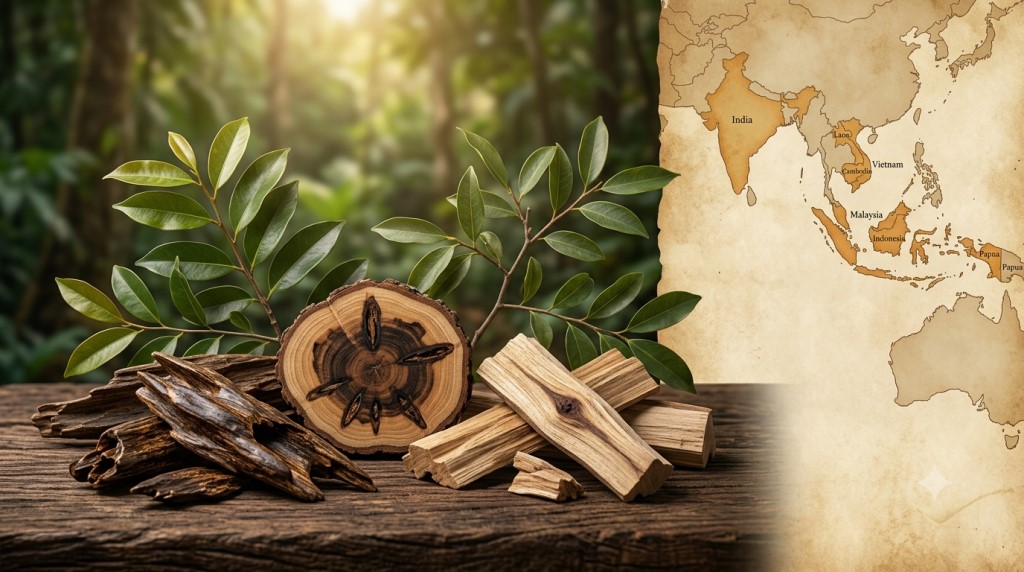
Anyone who has spent time around oud traders, incense collectors, or agarwood growers has probably noticed that the word “agarwood” gets used as if it describes one single thing. It doesn’t. Agarwood is a category, not a species, and understanding the types of agarwood behind that label is often the difference between buying something genuinely rare and paying premium prices for something far more common.
At Jungle Agarwood, we get asked constantly why one batch of oud chips smells sweet and syrupy while another feels sharp, green, or almost medicinal. The answer usually comes down to which tree the resin came from. Agarwood is produced by a group of trees in the Thymelaeaceae family, mainly within two genera — Aquilaria and Gyrinops — and each species carries its own character shaped by genetics, geography, and the specific fungal activity that triggered resin formation in the first place.
This guide walks through the major agarwood species worth knowing, starting with the most historically significant one, Aquilaria malaccensis, before moving into the Gyrinops genus and a handful of lesser-known contributors to the world’s agarwood supply.
Why Agarwood Species Actually Matter
Before getting into the list of species, it’s worth explaining why this distinction isn’t just academic. Two pieces of “agarwood” can differ enormously in aroma, resin density, and market price depending on which species produced them. A trader selling Aquilaria crassna from Cambodia and one selling Gyrinops versteegii from Flores are, technically, both selling agarwood — but the products are not interchangeable in scent, rarity, or use.
Species also affects how a tree behaves in cultivation. Some species respond to resin-inducing techniques faster than others, which has real consequences for plantation growers deciding what to plant and how long they’ll wait before their first harvest. If you’re new to how that resin actually develops, our article on how agarwood is formed covers the biological process in more depth.
The Two Genera Behind Nearly All Commercial Agarwood
Aquilaria: The Backbone of the Classical Oud Trade
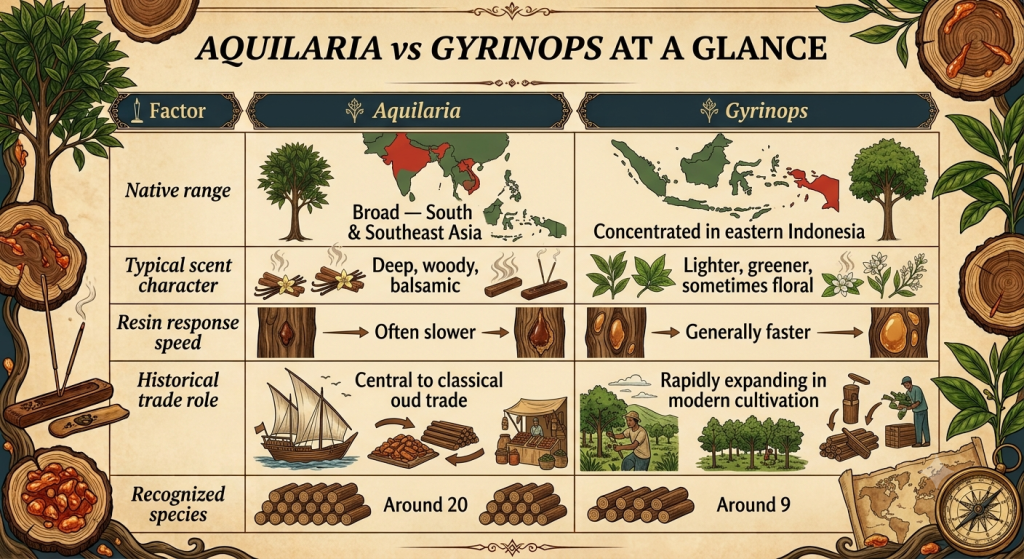
Most of what has historically been traded as agarwood — the resin referenced in old Arab perfumery manuscripts, Ayurvedic texts, and Chinese medicine records — comes from the genus Aquilaria. It’s the larger of the two genera, with around twenty recognized species distributed from India and Bangladesh through Myanmar, Thailand, Vietnam, Cambodia, Laos, Malaysia, and Indonesia.
Aquilaria resin tends to lean deep and woody, though the specifics vary widely by species and origin. Some varieties lean sweet and almost caramelized, others read as smoky or animalic, and still others come across as spicy or leathery. This range is part of what makes Aquilaria agarwood so central to traditional oud blending — there’s enormous room for nuance within a single genus.
Gyrinops: Indonesia’s Rising Contribution
Gyrinops is a smaller genus, concentrated almost entirely in eastern Indonesia — Papua, the Maluku Islands, and Nusa Tenggara, including Flores and Sumbawa. It’s been part of local incense traditions for generations, but its role in the international market has grown considerably over the past couple of decades, largely because Gyrinops trees tend to respond to resin induction faster than most Aquilaria species.
That speed matters enormously to plantation economics. Where an Aquilaria tree might take many years to develop commercially viable resin under managed cultivation, some Gyrinops species can shorten that timeline meaningfully. That’s part of why Indonesian growers have leaned so heavily into Gyrinops cultivation in recent years, a trend we unpack further in our agarwood plaintation guide.
Aquilaria Malaccensis: The Species That Defined the Genus
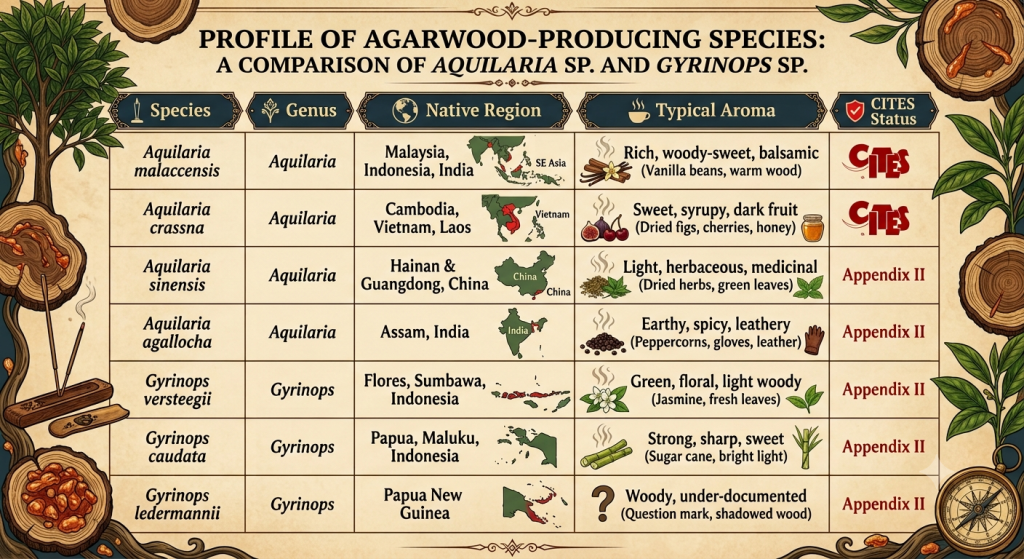
If there’s one species worth knowing above the rest, it’s Aquilaria malaccensis. It was the first species formally described within the genus, and for centuries it served as something like the reference point against which other agarwood was judged. Native to Malaysia, Indonesia, and parts of India, it produces a resin generally described as rich, deep, and balsamic, with a woody sweetness that made it a favorite in classical Middle Eastern and South Asian perfumery.
Wild populations of Aquilaria malaccensis have taken a hard hit from decades of overharvesting, which is why it was among the first agarwood species listed under CITES Appendix II. Today, most legally traded A. malaccensis comes from managed plantations rather than wild forest stands — a shift that has become fairly standard across the industry as governments and growers try to keep the species commercially viable without depleting what’s left in the wild. Our page on Aquilaria trees goes deeper into the botany behind this genus if you want the full picture.
Aquilaria Crassna: The Source of Classic Cambodian Oud
Ask any longtime oud collector to name their favorite regional profile, and Cambodian agarwood comes up often. That reputation largely traces back to Aquilaria crassna, native to Cambodia, Vietnam, and Laos. It’s known for a distinctly sweet, almost dessert-like resin — think dark caramel and dried fruit layered over a deep woody base — which is part of why “Cambodi” oud commands such loyal followings among collectors.
Provinces like Pursat and Koh Kong in Cambodia have long been associated with particularly prized A. crassna material, though as with most agarwood, exact resin quality still depends heavily on the individual tree’s age, infection history, and harvest conditions.
Aquilaria Sinensis: China’s Traditional Agarwood
In China, agarwood isn’t just a fragrance ingredient — it’s deeply woven into incense culture and Traditional Chinese Medicine, where it’s known as chenxiang (沉香). The species behind most of that tradition is Aquilaria sinensis, native to Hainan and Guangdong provinces.
Compared to the deep, syrupy character often associated with Cambodian agarwood, A. sinensis tends to present a lighter, more herbaceous and slightly medicinal profile. China has invested heavily in domestic plantation cultivation of this species, partly in response to strict conservation regulation protecting wild populations.
Aquilaria Agallocha: India’s Agarwood Heritage
Native to Assam in Northeast India, Aquilaria agallocha (sometimes referred to as Aquilaria khasiana) carries centuries of history in Indian and Ayurvedic tradition, where agarwood is simply called agar. Its resin tends to read as earthy and spicy, often with a leathery edge that sets it apart from the sweeter Southeast Asian varieties.
This species remains closely tied to religious and ceremonial use across South Asia, and demand for authentic Assamese agarwood continues to support a meaningful domestic cultivation industry in the region.
Gyrinops Versteegii: The Workhorse of Indonesian Plantations
Within the Gyrinops genus, Gyrinops versteegii is by far the most widely cultivated species, grown extensively across Flores, Sumbawa, and Sumba. Its resin tends to be lighter and greener than typical Aquilaria material, sometimes showing citrus or floral top notes before settling into a woody base.
Because it responds relatively quickly to resin induction, G. versteegii has become a go-to choice for growers looking for a faster path to market. You’ll often see it sold under regional trade names like “Bajau” or “Sumbawa” agarwood rather than its scientific name, which can make species identification tricky for buyers unfamiliar with Indonesian sourcing conventions.
Gyrinops Caudata: Papua’s Aromatic Standout
Gyrinops caudata, found primarily in Papua and parts of the Maluku Islands, is generally regarded as one of the more aromatically intense Gyrinops species. Its resin carries a strong, slightly sharp character with a sweetness that tends to develop and round out over time. Within Indonesia’s domestic oud market, it’s often held in high regard, sometimes commanding prices that approach premium Aquilaria grades.
Gyrinops Ledermannii and Other Lesser-Known Species
Beyond the well-documented species, a handful of lesser-known Gyrinops varieties exist in more remote parts of Papua New Guinea and eastern Indonesia, including Gyrinops ledermannii. These species see limited international trade and remain under-researched, though growing interest in plantation diversification has put them on the radar of agricultural researchers exploring new cultivation options.
Beyond Aquilaria and Gyrinops
A small number of other genera occasionally produce resinous wood traded locally as agarwood-adjacent material. Gonystylus, found in parts of Borneo and Sumatra, and Aetoxylon, native to Borneo, both have regional incense traditions attached to them, though neither is nearly as standardized or internationally recognized as Aquilaria or Gyrinops. Notably, these genera also fall outside the CITES framework that governs the more established agarwood species, which raises its own questions about traceability and sustainable sourcing — something we explore further in our guide to sustainable agarwood.
Comparing the Major Agarwood Species
Aquilaria vs Gyrinops at a Glance
What Species Selection Means for Growers and Buyers
For anyone buying agarwood — whether it’s oil, chips, or raw wood — knowing the species behind a product is one of the more reliable ways to judge whether the price matches what you’re actually getting. A bottle labeled simply “agarwood oil” could be Aquilaria or Gyrinops, wild-harvested or plantation-grown, and those distinctions alone can account for significant price swings. Our buying agarwood guide walks through how to ask the right questions before making a purchase.
Growers face a parallel decision. Choosing which species to plant isn’t just a matter of preference — it shapes how long the investment takes to mature, how the tree performs in local soil and climate, and what kind of resin profile the eventual harvest will produce. Many operations today plant a mix of species specifically to hedge against these variables, something covered in more detail on our agarwood grades page, since grading standards often reference species as one input among several.
Frequently Asked Questions
How many types of agarwood are there? Researchers generally recognize somewhere between fifteen and twenty-four species capable of producing agarwood resin, the vast majority falling within the genera Aquilaria and Gyrinops, with a small number from Gonystylus and Aetoxylon.
What’s the difference between Aquilaria and Gyrinops agarwood? Aquilaria species typically produce a deeper, sweeter, more balsamic resin and are found across a much wider geographic range, while Gyrinops species — concentrated in eastern Indonesia — tend to yield a lighter, greener resin that often develops faster under cultivation.
Which type of agarwood is considered the most valuable? Value depends on more than species alone — age, origin, and resin density all play a role — but wild Aquilaria crassna from Cambodia and old-growth Aquilaria malaccensis have historically commanded some of the highest prices in classical oud markets.
Is every type of agarwood protected under CITES? Yes, all recognized species within Aquilaria and Gyrinops are listed under CITES Appendix II, which requires permits for international trade to help prevent further depletion of wild populations.
Can a single plantation grow more than one type of agarwood? Yes, and it’s fairly common. Many Southeast Asian plantations cultivate a mix of species, often choosing a combination based on local climate suitability and the range of aroma profiles buyers are asking for.
Interested in Authentic Agarwood from Jungle Agarwood?
If you’re looking to buy genuine Aquilaria or Gyrinops agarwood — whether raw chips, oil, or plantation-grown material with clear species and origin information — our team at Jungle Agarwood is happy to help you find the right grade for your needs. Reach out to us directly on WhatsApp for pricing, availability, and species-specific recommendations:
Order via WhatsApp
Final Thoughts
Understanding the different types of agarwood isn’t just useful trivia — it’s genuinely practical knowledge for anyone buying, growing, or simply appreciating oud. From the historically dominant Aquilaria malaccensis to the fast-growing Gyrinops versteegii and the rarer species scattered across Borneo and Papua, each type of agarwood carries its own story shaped by geography, biology, and centuries of trade. The more familiar you become with these distinctions, the easier it becomes to spot quality, understand pricing, and appreciate why no two pieces of agarwood ever smell quite the same.