
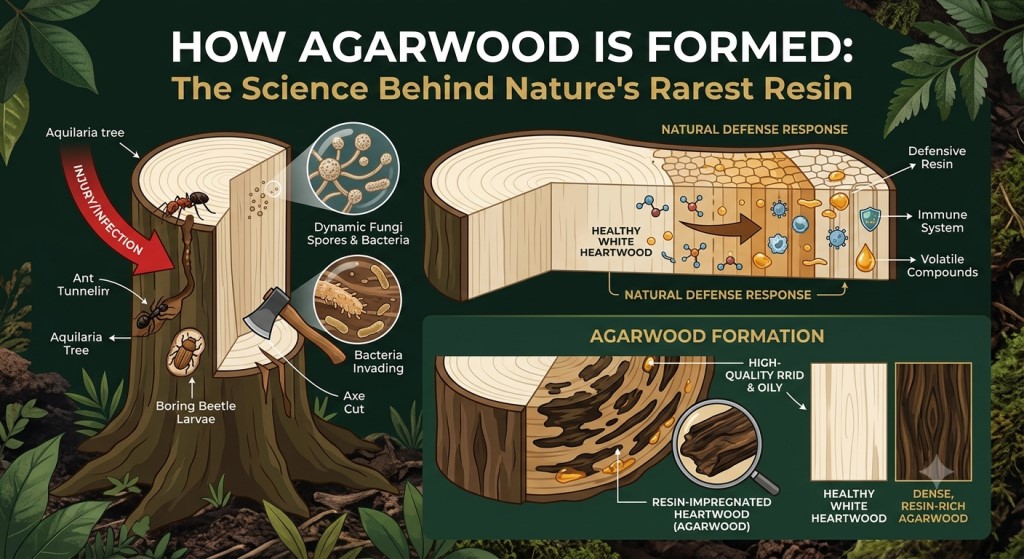
One of the strangest facts about agarwood is that the tree that produces it doesn’t actually want to make it. Unlike most valuable natural materials, which come from a plant’s normal growth process, agarwood only exists because something went wrong first. A healthy Aquilaria or Gyrinops tree, left completely undisturbed, will never produce a single gram of the resin that makes agarwood so valuable — it takes injury, infection, and a very specific biological response for that transformation to happen at all.
In our guide to what agarwood is, we touched briefly on this formation process. This article goes much deeper, walking through exactly how agarwood forms, why it takes so long under natural conditions, and how modern cultivation has developed ways to trigger the same process more reliably on plantations. Understanding this process isn’t just interesting botany — it directly explains why agarwood grades vary so dramatically and why certain species and regions are known for particular resin characteristics.
The Tree’s Defense Mechanism, Explained
Aquilaria and Gyrinops trees, like most plants, have built-in defense systems that activate when the tree suffers damage or detects a pathogen. In most trees, this response simply seals off the wound and moves on. In Aquilaria and Gyrinops specifically, something more unusual happens: the tree responds to certain types of fungal infection by producing an unusually rich concentration of secondary metabolites — compounds not directly involved in the tree’s normal growth or reproduction, but produced specifically as chemical defense.
Over time, as the tree continues fighting the infection, these compounds accumulate in the surrounding wood tissue, gradually darkening and thickening into the dense, aromatic resin we know as agarwood. This is why agarwood only ever forms in the heartwood immediately surrounding an infection site or wound — the rest of the tree’s wood remains pale, light, and essentially scentless, exactly as it would in any uninfected tree.
What Triggers Agarwood Formation in the Wild
In natural forest conditions, several things can set this process in motion, and it’s rarely just one single cause. The most commonly cited trigger is fungal infection, particularly by certain mold and fungal species that colonize wounded or stressed trees. Insect activity, especially boring insects that damage bark and inner wood, frequently creates the entry point fungi need to establish infection. Physical damage from storms, lightning strikes, or even animal activity can also open the door for the same fungal colonization to begin.
Age and environmental stress play a role too. Older trees, and trees growing in less-than-ideal conditions, appear more susceptible to the kind of sustained infection that leads to substantial resin formation, which is part of why old-growth wild agarwood has always carried a certain mystique and premium value compared to younger material.
Crucially, this process is unpredictable in the wild. Only a small percentage of Aquilaria or Gyrinops trees in a given forest will ever develop commercially significant resin, and even among those that do, resin quality and quantity vary enormously from tree to tree. This natural unpredictability is the single biggest reason wild agarwood has always been scarce, regardless of how many trees of the right species happen to be growing in a region.
How Long Does Natural Agarwood Formation Take?
There’s no fixed timeline, but natural resin formation is a slow process by almost any measure, often unfolding over many years and sometimes multiple decades before a tree develops resin dense enough to be commercially valuable. This extended timeline reflects the gradual, cumulative nature of the tree’s defense response — resin doesn’t appear suddenly after an infection, but builds incrementally as the tree continues responding to ongoing fungal activity within the wound site.
This slow natural timeline is precisely why wild agarwood, when it’s found in genuinely old, deeply resinated form, commands such extraordinary prices. It represents years of biological process that simply can’t be rushed under fully natural conditions, concentrated into a relatively small volume of usable, resin-dense wood.
Modern Inoculation: Speeding Up Nature
Given how slow and unpredictable natural resin formation is, it’s no surprise that plantation growers have spent decades developing techniques to trigger the same biological response more reliably and on a shorter timeline. This process, broadly known as inoculation, involves deliberately introducing fungal agents or creating controlled wounds in a tree’s trunk to prompt the same defensive resin production that would otherwise depend on chance infection in the wild.
Inoculation methods vary by grower and region, ranging from drilling small holes and introducing fungal cultures directly, to more advanced techniques involving specific fungal strains selected for their reliability in triggering strong resin response. Done well, inoculation can meaningfully shorten the wait between planting a tree and harvesting commercially viable resin, which has been central to making plantation-grown agarwood economically viable at scale.
It’s worth noting that inoculated agarwood isn’t automatically lower quality than wild material — quality still depends heavily on the specific technique used, the tree’s individual response, species, and how long the resin is allowed to develop after inoculation before harvest. Well-managed plantations using effective techniques can produce genuinely high-grade resin, closing much of the gap that once existed between wild and cultivated agarwood.
Wild vs Induced Agarwood: What Actually Differs
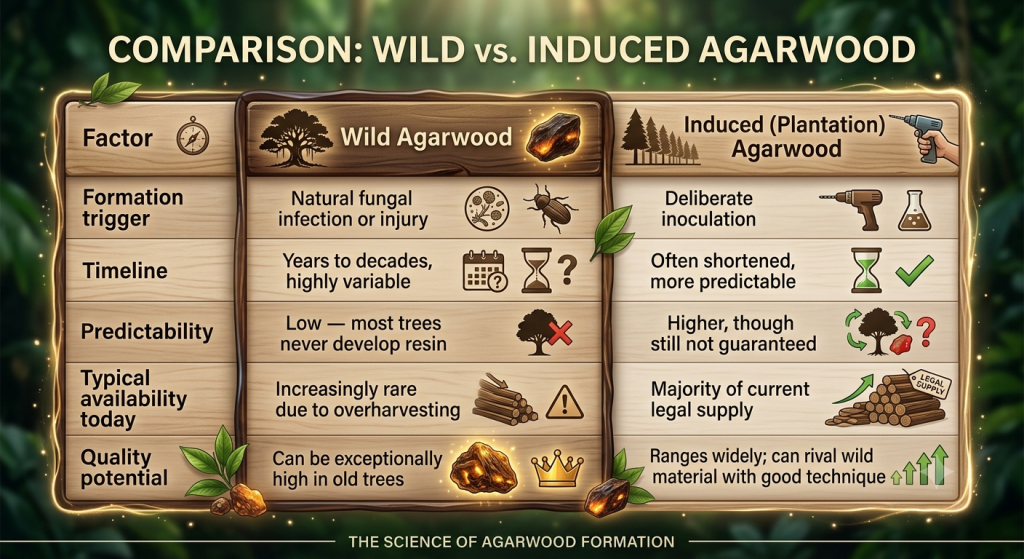
This distinction matters for buyers trying to understand pricing and availability. As covered in our buying agarwood guide, most legally traded agarwood today comes from managed, inoculated plantations rather than wild harvest, largely due to conservation pressure on wild populations documented under CITES.
Why Resin Formation Explains So Much About Agarwood Quality
Once you understand how agarwood actually forms, a lot of what determines grade and value starts to make more intuitive sense. Resin density — the core factor separating AB grade from Triple Super, as detailed in our agarwood grades guide — is really just a reflection of how long and how thoroughly a tree’s defense response had time to develop before harvest. Denser, more continuous resin generally means either a longer natural formation period or a particularly effective and well-timed inoculation process.
Aroma complexity connects to this process too. The specific fungal strains involved in infection, along with the tree’s individual biochemistry, species, and growing environment, all influence the exact chemical composition of the resulting resin — which is ultimately what gives different species and regions their distinct aromatic signatures, as explored in our guides to agarwood species and origin regions.
The Sustainability Angle
Understanding formation also clarifies why sustainable cultivation has become so central to the modern agarwood industry. Because natural formation is slow and unpredictable, relying purely on wild harvest was never going to meet sustained global demand without depleting wild tree populations — which is exactly what happened across much of Aquilaria’s native range over the past several decades, prompting the CITES Appendix II listing that now governs international trade.
Inoculation technology essentially decouples agarwood supply from the scarcity of naturally infected wild trees, allowing growers to plant trees specifically for eventual resin production rather than searching forests for the small percentage that happen to be naturally infected. This shift is central to the industry’s long-term sustainability, a topic we explore fully in our sustainable agarwood guide and our overview of agarwood plantation practices.
What Research Says About Resin Chemistry
Scientific interest in agarwood formation has grown considerably over the past couple of decades, partly driven by the industry’s shift toward plantation cultivation and the need to make inoculation more reliable and predictable. Researchers studying resin biosynthesis have identified specific classes of aromatic compounds, including various sesquiterpenes and chromone derivatives, that accumulate during the infection response and are largely responsible for agarwood’s distinctive scent profile.
This research has practical implications beyond pure botany. Understanding which fungal strains most reliably trigger strong resin production, and which environmental conditions support that process most effectively, has allowed growers to refine inoculation techniques considerably compared to early plantation efforts decades ago. It’s also helped explain why resin composition, and therefore scent, can vary so much even among trees of the same species grown in different conditions — the specific mix of compounds produced depends on a combination of fungal strain, tree genetics, and environmental stress factors that rarely line up identically twice.
For growers and buyers alike, this growing body of research reinforces a theme that runs throughout the agarwood industry: quality isn’t random, even when it looks unpredictable on the surface. It’s the product of specific, identifiable biological factors that, increasingly, can be understood and even partially controlled rather than left entirely to chance.
Frequently Asked Questions
Why doesn’t every Aquilaria tree produce agarwood? Agarwood only forms in response to specific fungal infection or significant injury, and not every tree encounters the right conditions or successfully develops the sustained defense response needed to produce commercially significant resin.
How long does it take for agarwood to form naturally? Natural formation is highly variable but generally takes years, and often decades, since resin accumulates gradually as a tree continues responding to an ongoing infection or wound.
What is agarwood inoculation? Inoculation is a plantation cultivation technique that deliberately introduces fungal agents or controlled wounds into a tree to trigger the same resin-producing defense response that would otherwise depend on random infection in the wild.
Is inoculated agarwood lower quality than wild agarwood? Not necessarily. Quality depends on the specific technique, species, and development time after inoculation, and well-managed plantations can produce resin quality that rivals wild-harvested material.
Does the type of fungus affect agarwood’s scent? Yes. Different fungal strains, combined with a tree’s species and growing environment, influence the resin’s chemical composition, which is part of why agarwood aroma varies so much by species and region.
Curious About Genuine, Well-Formed Agarwood from Jungle Agarwood?
Now that you understand how agarwood actually forms, you’re better equipped to evaluate the resin quality behind any piece you’re considering. Our team at Jungle Agarwood can walk you through specific batches, their formation background, and grading details. Reach out on WhatsApp for current stock and guidance:
Final Thoughts
How agarwood is formed comes down to a tree’s defensive response to infection or injury, gradually transforming ordinary heartwood into one of the world’s most prized aromatic materials over months, years, or even decades. Whether that process happens naturally in a wild forest or is deliberately triggered through modern inoculation on a plantation, understanding how agarwood forms explains nearly everything else about the material — why it’s rare, why grades vary so widely, and why species and origin shape its final character so profoundly.
That knowledge turns agarwood from a mysterious luxury material into something you can genuinely understand and evaluate for yourself. The next time you come across a piece of agarwood, whether it’s a chip, a bottle of oil, or a bead on a bracelet, you’ll have a real sense of the biological process, sometimes stretching back years, that went into creating it.