
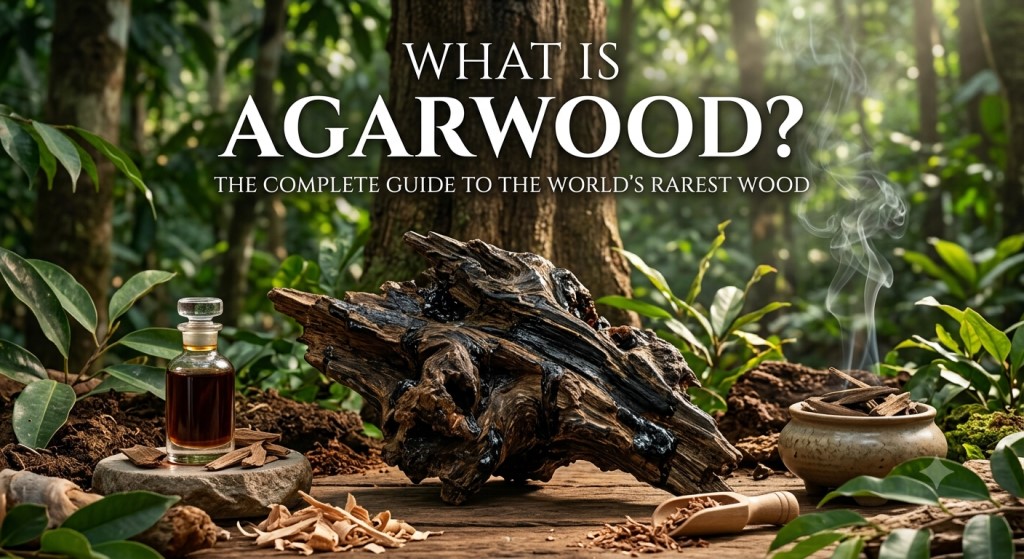
If you’ve ever caught a deep, smoky-sweet scent drifting from a temple, a perfume counter, or a friend’s wooden bracelet and wondered what it actually was, there’s a good chance the answer was agarwood. It’s one of the most valuable natural materials in the world, prized across cultures for centuries, yet most people who encounter it — whether as oud perfume, incense, or jewelry — have never quite understood what agarwood actually is or why it commands the prices it does.
At its simplest, agarwood is a resin-infused wood formed inside certain trees as a natural defense response to injury or infection. But that short definition undersells just how unusual and genuinely rare this material is. This guide walks through what agarwood actually is, how it forms, which trees produce it, why it has been valued for thousands of years, and how it ends up in the products people encounter today.
What is Agarwood, Exactly?
Agarwood is the dark, resin-saturated heartwood that develops inside trees belonging primarily to the genera Aquilaria and Gyrinops, both part of the Thymelaeaceae plant family. In its healthy state, the wood from these trees is pale, lightweight, and essentially odorless. It’s only after a tree becomes wounded or infected — typically by certain fungi, insects, or physical damage — that it begins producing a dark, aromatic resin as a protective response, gradually transforming ordinary heartwood into what the world knows as agarwood.
This resin is what gives agarwood its value. It’s also what gets extracted into oud oil, ground into incense, and carved into fragrant jewelry beads. Without infection or injury, an Aquilaria or Gyrinops tree will simply never produce commercially valuable resin, no matter how old it grows — which is a big part of why genuine, high-quality agarwood has always been relatively scarce, even in regions where these trees grow abundantly.
How Agarwood Actually Forms
The formation process is genuinely fascinating from a botanical standpoint. When a tree is wounded — by a broken branch, insect boring, or fungal infection — it responds by producing secondary metabolites, essentially defensive chemical compounds, in the surrounding tissue. Over time, in trees that are susceptible to this particular kind of infection, these compounds accumulate and darken, eventually forming the dense, aromatic resin that defines agarwood.
This process can take years, sometimes decades, under natural wild conditions, which is one reason old-growth wild agarwood has always carried premium value. Modern plantation cultivation has developed techniques to accelerate this process through deliberate inoculation — introducing fungal agents or controlled wounding to trigger resin production more predictably and on a shorter timeline. We cover this transformation process step by step in our dedicated guide on how agarwood is formed, which goes deeper into the biology behind it.
Which Trees Produce Agarwood?
Not every tree in the Thymelaeaceae family produces agarwood, and even among the species capable of it, only a fraction of trees in a given forest will actually develop resin naturally. The two genera responsible for the overwhelming majority of commercial agarwood are:
- Aquilaria — the larger genus, with roughly twenty recognized species distributed across South and Southeast Asia, including well-known species like Aquilaria malaccensis, Aquilaria crassna, and Aquilaria sinensis
- Gyrinops — a smaller genus concentrated in eastern Indonesia, including species such as Gyrinops versteegii and Gyrinops caudata
Each species produces resin with its own aromatic tendencies, and origin adds another layer of variation on top of that. We break down the major species in detail in our types of agarwood guide, and the regional differences across Indonesia specifically in our article on agarwood origin regions.
Why is Agarwood So Valuable?
A few factors combine to make agarwood one of the most expensive natural materials in the world, sometimes compared to precious metals by weight for the highest grades.
First, there’s genuine scarcity. Resin formation depends on natural infection that doesn’t occur predictably or in every tree, meaning high-quality wild agarwood has always been rare relative to demand. Second, extraction and processing are labor-intensive — identifying which parts of a tree actually carry resin, harvesting it, and either preparing raw wood or distilling oil all require skill and time. Third, demand has remained consistently strong for centuries across multiple, independent cultural traditions simultaneously, from Middle Eastern perfumery to East Asian incense culture to South Asian religious practice, which has kept pressure on limited supply.
Finally, quality varies enormously even within genuine agarwood, which is where grading comes in. Material with dense, well-developed resin commands dramatically higher prices than lighter, less-infused wood, a distinction we explore fully in our agarwood grades guide covering classifications like Super, Double Super, and Triple Super.
A Brief History of Agarwood’s Global Significance
Agarwood’s use stretches back thousands of years across multiple, largely independent cultural traditions. In the Middle East, agarwood — known there as oud — became central to perfumery and hospitality customs, burned to welcome guests and distilled into some of the region’s most treasured fragrances. In China, agarwood, referred to as chenxiang, holds deep roots in Traditional Chinese Medicine and incense culture, associated with calming and grounding qualities. In South Asia, particularly India, agarwood appears throughout Ayurvedic tradition and religious ceremony, often referred to simply as agar.
Buddhist and Hindu traditions across South and Southeast Asia have also long used agarwood incense in temple ceremonies and meditation practice, a use that continues today throughout much of Asia. This convergence of independent cultural traditions, all separately arriving at deep appreciation for the same material, is part of what makes agarwood’s history so distinctive compared to many other prized natural resources.
How Agarwood Becomes the Products You See Today
Raw agarwood wood is really just the starting point. From there, the material gets transformed into a range of different products depending on its grade, species, and intended use:
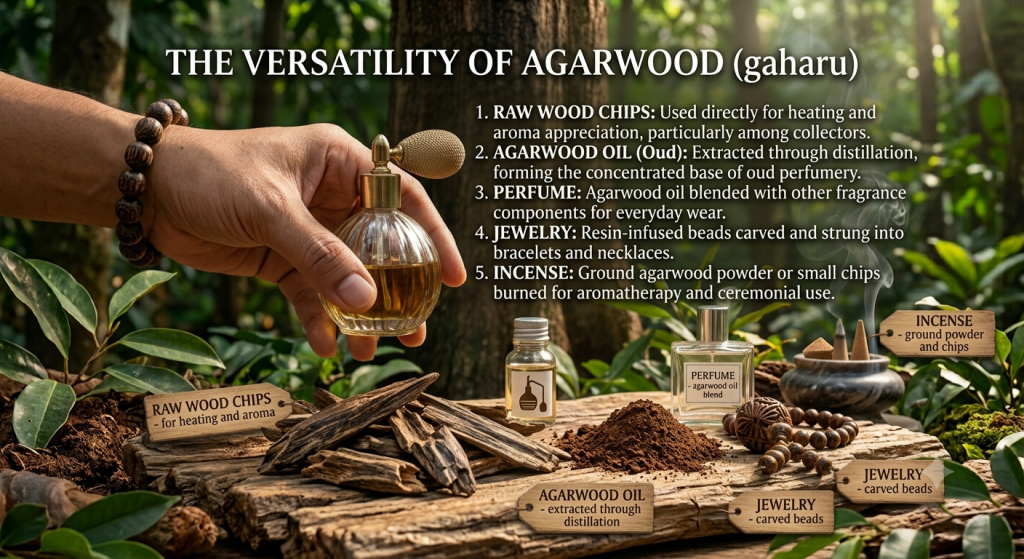
We cover each of these product categories in much greater depth in our guide to agarwood products, including how to think about which format actually suits your needs.
Agarwood vs Oud: Clearing Up a Common Confusion
One point of confusion worth addressing directly: agarwood and oud aren’t two different materials — they’re largely the same thing described through different regional vocabulary. “Agarwood” tends to be the term used in English-language botanical and trade contexts, referring broadly to the resin-infused wood itself, while “oud” is the term more commonly used across the Middle East, often referring specifically to the wood, the oil, or fragrances derived from it. In practice, the terms overlap heavily, and you’ll see both used interchangeably depending on the source.
Conservation Status and Sustainable Sourcing
Because natural agarwood formation is relatively rare and demand has remained high for centuries, wild populations of several Aquilaria species have faced significant pressure from overharvesting. In response, all recognized species within Aquilaria and Gyrinops are now listed under CITES Appendix II, requiring permits for international trade to help prevent further depletion of wild stands.
This conservation pressure has driven a major shift toward plantation cultivation combined with artificial inoculation techniques across Indonesia, Malaysia, Vietnam, and Cambodia, allowing the industry to meet demand while reducing reliance on wild harvest. This shift is central to the agarwood trade’s long-term future, and it’s a topic we cover in full in our sustainable agarwood guide.
How to Recognize Genuine Agarwood
Given its high value, agarwood is unfortunately one of the more commonly counterfeited natural materials, particularly in oil and perfume form where synthetic alternatives can be difficult to distinguish without experience. A few characteristics help separate genuine agarwood from imitations. Real agarwood resin tends to be visually uneven within a piece of wood — resin doesn’t distribute perfectly evenly, so streaks, pockets, and gradients of color are normal, whereas artificially treated wood often shows suspiciously uniform darkening throughout.
Scent is another reliable indicator, though it takes some experience to read accurately. Genuine agarwood, when gently heated rather than burned outright, tends to release a complex, evolving aroma that shifts over several minutes, often moving through multiple distinct notes rather than presenting one flat, static smell. Synthetic oud fragrances, by contrast, frequently smell similar from the first moment to the last, lacking that natural progression.
Weight and density offer a practical field test as well. High-resin agarwood is dense enough that quality chips will often sink in water, while wood with little or no real resin content typically floats. None of these checks are entirely foolproof on their own, which is why buying from a knowledgeable, transparent seller remains the most reliable safeguard — a theme we return to throughout our buying agarwood guide.
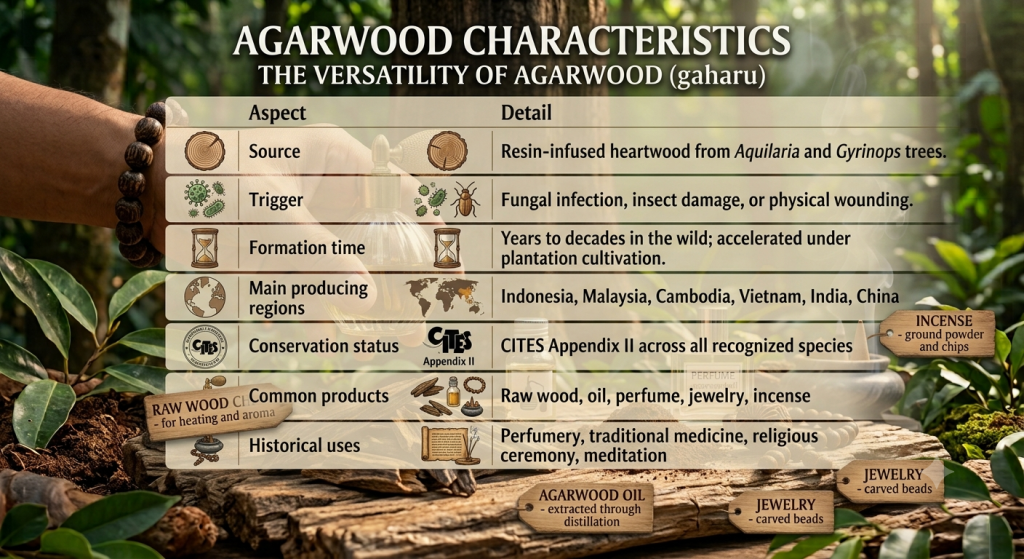
Agarwood at a Glance
Frequently Asked Questions
What is agarwood used for? Agarwood is used across several categories, including raw wood for direct aroma appreciation, distilled oil for perfumery, carved jewelry, blended perfume, and incense for aromatherapy and religious ceremony.
Why is agarwood so expensive? Agarwood’s price reflects genuine scarcity, since resin only forms in trees that become naturally infected or injured, combined with labor-intensive harvesting and processing and centuries of sustained global demand across multiple cultures.
Is agarwood the same as oud? Largely, yes. “Agarwood” and “oud” refer to the same resin-infused wood and its derivatives, with “agarwood” more common in English botanical contexts and “oud” more commonly used across Middle Eastern trade and perfumery.
What tree does agarwood come from? Agarwood primarily comes from trees in the genera Aquilaria and Gyrinops, both part of the Thymelaeaceae family, native across South and Southeast Asia, including Indonesia, Malaysia, Cambodia, Vietnam, India, and China.
Is all agarwood wild-harvested? No. While wild agarwood still exists, most legally traded agarwood today comes from managed plantations using cultivation and inoculation techniques, largely due to conservation pressure on wild populations documented under CITES.
Looking to Explore Genuine Agarwood from Jungle Agarwood?
Now that you know what agarwood actually is, exploring our other guides on species, grading, and products is a great next step — or you can reach out directly to our team for personalized recommendations based on what you’re looking for. Contact us on WhatsApp for current stock, pricing, and guidance:
Final Thoughts
So, what is agarwood, in the end? It’s a resin-infused wood formed through a rare, largely unpredictable natural process, transformed by centuries of global demand into one of the world’s most valued aromatic materials. From its formation inside infected Aquilaria and Gyrinops trees to its journey into oud oil, incense, perfume, and jewelry, agarwood carries a depth of history and craftsmanship that few other natural materials can match.
Understanding what agarwood is — and how species, grade, and origin all shape its character — is the foundation for appreciating everything else this remarkable wood has to offer. Whether you’re buying your first bottle of oud oil, a bracelet, or a bag of raw chips, that foundation makes the rest of the journey, from choosing a species to evaluating a grade, far easier to navigate with confidence.