
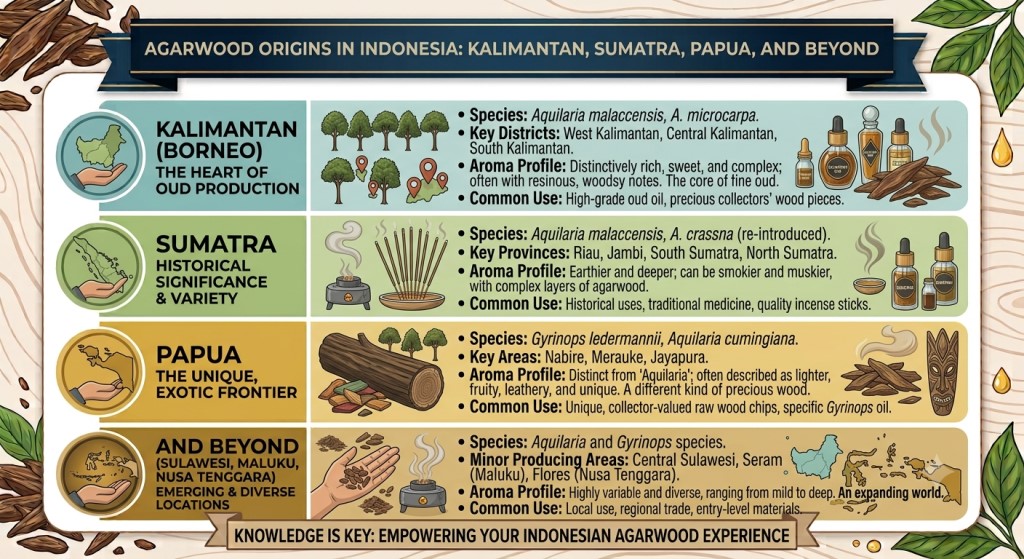
Indonesia isn’t just one of the world’s largest agarwood producers — it’s arguably the most geographically diverse one. Stretching across thousands of islands, the archipelago hosts wildly different growing conditions, from the dense lowland rainforests of Kalimantan to the highland terrain of Sumbawa and the remote forests of Merauke in Papua. That diversity matters more than most buyers realize, because where agarwood grows shapes what it smells like almost as much as which species produced it.
We’ve already covered how species affects agarwood character in our guide to the types of agarwood, and how resin density shapes commercial agarwood grades. This article picks up the third major variable: origin. Knowing whether a piece of agarwood came from Kalimantan, Sumatra, Merauke, Sumbawa, Sulawesi, or the Maluku islands gives you real, practical insight into what to expect from it — and it’s information serious buyers routinely ask for alongside species and grade.
Why Origin Shapes Agarwood Character
Agarwood resin forms as a defensive response when a tree in the Thymelaeaceae family is wounded or infected, typically by specific fungal strains. Those fungal strains, along with soil composition, humidity, elevation, and rainfall patterns, vary significantly from one Indonesian island to another. Even when the same species grows in two different regions, the resulting resin can carry noticeably different aromatic qualities — which is exactly why the trade so often pairs a region name with a grade or species when describing a batch of agarwood.
This is also why experienced buyers rarely ask “what agarwood is this?” without also asking where it came from. Origin functions almost like a regional accent layered on top of a species’ base character, and recognizing that accent is a genuinely useful skill for anyone buying agarwood regularly.
Kalimantan: Deep, Earthy Borneo Character
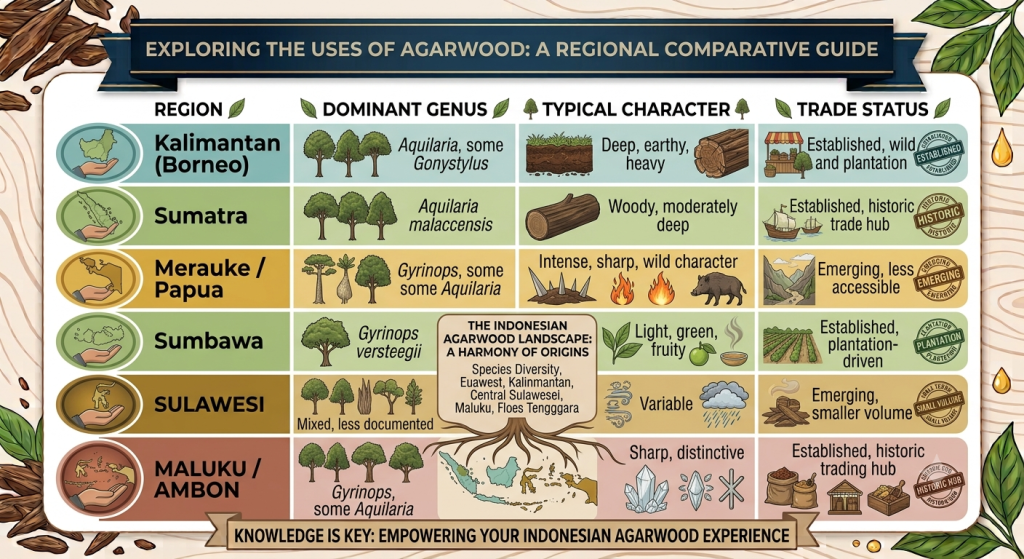
Kalimantan, the Indonesian portion of Borneo, is one of the country’s most significant agarwood-producing regions, home to extensive wild and semi-wild Aquilaria populations along with pockets of Gonystylus, a lesser-known resin-producing genus found in the region’s forests. Kalimantan agarwood is generally associated with a deep, earthy, and somewhat heavier resin profile compared to material from Indonesia’s eastern islands.
The island’s vast rainforest cover has historically supported substantial wild harvesting, though like much of Indonesia, sustainable plantation cultivation has expanded here in recent years as wild stocks have come under increasing pressure. Kalimantan agarwood tends to be well regarded among traditional oud collectors who favor darker, more grounded aroma profiles over the lighter, brighter notes associated with some eastern Indonesian material.
Sumatra: Historic Trading Roots
Sumatra holds a long history in the agarwood trade, partly due to its geographic position along historic maritime trading routes connecting Southeast Asia to South Asia and the Middle East. Aquilaria malaccensis populations native to Sumatra contributed to some of the earliest agarwood exports from the archipelago, and the island remains an active source of both wild-origin material and increasingly, plantation-grown wood.
Sumatran agarwood is often described in similar terms to Kalimantan material — woody, resinous, and moderately deep — though regional variation within the island itself is considerable, given its size and range of forest ecosystems from lowland peat forests to highland terrain.
Merauke and Papua: Intense, Wild Character
Merauke, located in the far southeastern corner of Papua, represents one of Indonesia’s more remote and increasingly notable agarwood-producing areas. Papua broadly is associated with strong Gyrinops populations, particularly Gyrinops caudata, alongside Aquilaria species in certain areas, and the region has built a reputation for producing intensely aromatic, sometimes sharper-scented resin compared to more commonly traded western Indonesian material.
Because Papua’s forests remain comparatively less accessible and less intensively harvested than islands like Sumatra or Kalimantan, agarwood from this region — including Merauke specifically — often carries a certain mystique among collectors seeking material perceived as closer to untouched wild-forest character. That said, buyers should still confirm species and sourcing details carefully, since regional reputation alone doesn’t guarantee quality in any individual batch.
Sumbawa: Fast-Growing Gyrinops Country
Sumbawa, part of the Nusa Tenggara island chain, has become one of Indonesia’s most important centers for cultivated Gyrinops versteegii, a species we covered in detail in our types of agarwood guide. The island’s climate and terrain have proven particularly well-suited to Gyrinops cultivation, and plantation programs here have scaled significantly over the past couple of decades.
Sumbawa agarwood is frequently associated with the lighter, greener, sometimes fruitier aromatic character typical of Gyrinops species generally, and material from this region is often sold under regional trade names referencing Sumbawa directly. For buyers specifically interested in Gyrinops rather than Aquilaria material, Sumbawa is one of the more reliable regions to look toward.
Sulawesi: An Emerging Source
Sulawesi’s agarwood industry is smaller and less internationally documented compared to Kalimantan, Sumatra, or the Nusa Tenggara islands, but the region does host both wild agarwood populations and a growing number of plantation initiatives. Sulawesi material tends to be less standardized in the international market simply due to lower trade volume, meaning quality and character can vary considerably from one source to another.
As demand for diversified, traceable agarwood sourcing grows, Sulawesi has drawn increasing interest from growers and researchers looking at underutilized regions with agarwood cultivation potential, though it remains a smaller player compared to Indonesia’s more established producing islands.
Maluku and Ambon: The Spice Islands’ Aromatic Legacy
The Maluku Islands, historically known as the Spice Islands, and Ambon specifically, carry a long-standing association with aromatic trade that predates the modern agarwood industry by centuries. Gyrinops species are well represented in this region, alongside pockets of Aquilaria, and Maluku agarwood is often noted for a distinctive, somewhat sharper resin character that regional buyers frequently seek out specifically.
Ambon, as the region’s historic trading hub, has functioned for generations as a collection and distribution point for agarwood harvested across the wider Maluku archipelago, which means material labeled as “Ambon agarwood” may originate from various surrounding islands rather than Ambon itself exclusively — a nuance worth asking about when precise origin matters to a purchase.
Comparing Indonesia’s Main Agarwood Regions
Why Origin Matters When You’re Buying
Region alone won’t tell you everything about a piece of agarwood — species and grade still carry enormous weight, as covered in our earlier guides — but origin adds meaningful context that helps set realistic expectations before you buy. Someone specifically seeking the deep, grounded profile associated with Kalimantan material is likely to be disappointed by a lighter Sumbawa Gyrinops batch, even if both are perfectly genuine, high-quality agarwood in their own right.
This is also where working with a seller who can speak specifically to sourcing region, not just species and grade, becomes genuinely useful. Our agarwood products guide covers how origin, species, and grade all combine to shape the final product, whether you’re buying raw wood, oil, or something else entirely, and our buying agarwood resource walks through the practical side of vetting sellers on these details.
Wild Harvest vs Plantation Cultivation Across Regions
Another dimension worth understanding is how each region’s agarwood supply has shifted, or hasn’t, from wild harvesting toward managed cultivation. Kalimantan and Sumatra, with their long histories of wild agarwood extraction, have seen significant depletion of naturally infected wild trees over past decades, pushing much of today’s legal supply from these islands toward plantation-grown Aquilaria, often supplemented with artificial resin induction techniques to speed up production.
Sumbawa tells a somewhat different story. Because Gyrinops versteegii responds relatively quickly to cultivation and inoculation, much of the island’s agarwood output today comes from purpose-planted trees rather than wild forest stands, making it one of the more sustainably positioned regions in the current market. Papua and Merauke, by contrast, still retain more wild-forest character in their agarwood supply simply due to lower accessibility and less developed plantation infrastructure, though that’s gradually changing as interest in the region grows.
This distinction matters for buyers who care about sustainability, not just aroma. A region’s shift toward plantation cultivation generally signals reduced pressure on wild populations, which ties directly into the broader conservation picture we cover in our sustainable agarwood guide.
Regional Reputation Isn’t a Substitute for Verification
It’s worth adding a note of caution here: regional names carry real weight in the agarwood trade, but they’re also sometimes used loosely or even inaccurately by sellers looking to capitalize on a region’s reputation. A batch marketed as “Kalimantan agarwood” or “Papua agarwood” should ideally come with some verifiable sourcing information, not just a label, particularly for higher-priced purchases.
This is where combining origin knowledge with the species and grading information covered earlier in this content series pays off. A seller who can confidently discuss species, region, and grade together — rather than leaning on a single impressive-sounding origin name — is generally a more trustworthy source than one relying on regional prestige alone to justify a price.
Frequently Asked Questions
Which Indonesian region produces the best agarwood? There’s no single “best” region — Kalimantan and Sumatra are known for deep, earthy Aquilaria profiles, while Sumbawa and Maluku are more associated with the lighter, distinctive character of Gyrinops species. The right choice depends on the aroma profile you’re after.
Is Papua agarwood different from Kalimantan agarwood? Yes, noticeably. Papua, including Merauke, tends to produce more Gyrinops-dominant material with an intense, sometimes sharper character, while Kalimantan is known for deeper, earthier Aquilaria-based resin.
What does “Ambon agarwood” actually mean? Ambon has historically served as a trading and collection hub for agarwood harvested across the wider Maluku Islands, so material labeled Ambon agarwood may originate from several surrounding islands rather than Ambon specifically.
Is Sumbawa agarwood mostly Gyrinops or Aquilaria? Sumbawa is primarily known for cultivated Gyrinops versteegii, making it one of the more reliable regions to source specifically for Gyrinops-species agarwood.
Does agarwood origin affect its price? Yes, though indirectly. Origin influences typical aroma character and available species, which in turn affects demand and pricing, but grade and resin density, covered in our agarwood grades guide, usually have a more direct impact on price than region alone.
Looking for Region-Specific Agarwood from Jungle Agarwood?
If you’re interested in agarwood from a specific Indonesian region — whether it’s the deep character of Kalimantan, the bright profile of Sumbawa, or the distinctive resin of Maluku — our team at Jungle Agarwood can help you source material with clear origin information. Reach out directly on WhatsApp for current stock and regional options:
Final Thoughts
Agarwood origin regions across Indonesia — Kalimantan, Sumatra, Merauke, Sumbawa, Sulawesi, and Maluku including Ambon — each bring their own combination of species, climate, and growing conditions to the final aroma of the wood. Alongside species and grade, understanding these agarwood origin regions gives buyers a fuller, more accurate picture of what they’re purchasing, and helps explain why two pieces of “Indonesian agarwood” can smell so different from one another depending on which island they came from.
As the agarwood industry continues shifting toward traceable, plantation-based sourcing, region is likely to become an even more prominent part of how the trade describes and prices its products, alongside the species and grade classifications already well established across the market. For buyers willing to learn these regional distinctions, that shift only makes it easier to find agarwood that genuinely matches what they’re looking for.