
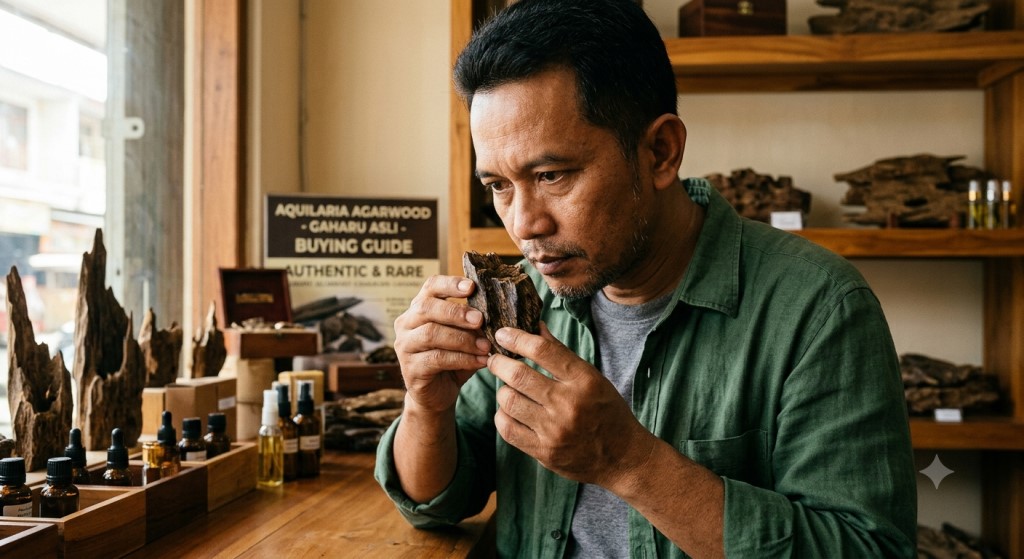
Buying agarwood for the first time can feel a little like walking into a conversation that’s already halfway through. Sellers throw around terms like “Double Super,” “Aquilaria crassna,” or “Kalimantan origin” as if everyone already knows what they mean, prices swing wildly between listings that look nearly identical, and it’s genuinely hard to tell whether you’re looking at a fair deal or an overpriced piece of ordinary wood with a fancy label attached.
We’ve spent the last several articles building up the pieces you need to buy genuine agarwood with actual confidence — covering what agarwood is, the major species, the grading system, the product categories it comes in, and the Indonesian regions it’s sourced from. This guide pulls all of that together into a practical framework for actually making a purchase, whether you’re buying raw wood, oil, jewelry, or incense.
Start With What You’re Actually Trying to Buy
Before evaluating any specific listing, it helps to get clear on what you actually want agarwood for, since that shapes which product category, grade, and price range make sense. Someone wanting a daily wearable scent has very different needs than someone building an oud oil collection or sourcing incense for regular meditation practice.
If you haven’t settled on a product category yet, our guide to agarwood products walks through raw wood, oil, jewelry, perfume, and incense in detail, including which format tends to suit different goals and budgets. Getting this decision right first prevents a common and expensive mistake: spending premium-grade prices on a product format where that level of quality won’t actually be noticeable or necessary.
Ask About Species Before You Ask About Price
Once you know what you’re buying, species should be one of the first questions you ask a seller — not an afterthought. As covered in our types of agarwood guide, Aquilaria and Gyrinops species carry genuinely different aromatic character, and within each genus, individual species like Aquilaria crassna or Gyrinops versteegii have their own reputations and price expectations.
A seller who can’t tell you which species a piece of agarwood comes from is either working with unverified stock or simply isn’t prioritizing that level of transparency — neither is necessarily disqualifying on its own, but it should factor into how much you’re willing to pay and how much verification you do yourself before purchasing.
Understand the Grade You’re Paying For
Grade names like AB, Super, Double Super, and Triple Super get used constantly in agarwood listings, and they should correlate directly with price. As we covered in our agarwood grades article, these classifications aren’t governed by a single global standard, which means the same grade name from two different sellers can represent somewhat different quality levels.
Practically, this means it’s worth asking sellers what criteria they use to assign grades — resin density, color, sinking behavior, aroma testing — rather than accepting a grade label at face value. Reputable sellers are usually happy to explain their grading process, and some will even offer photos or short videos showing resin distribution up close.
Consider Origin as a Quality Signal, Not a Guarantee
Origin adds useful context to a purchase, but it shouldn’t be treated as a substitute for verifying species and grade directly. As explored in our guide to agarwood origin regions, regions like Kalimantan and Sumatra tend toward deeper, earthier profiles, while Sumbawa and Maluku often lean lighter and brighter — useful information for setting aroma expectations, but not proof of authenticity or quality on its own.
Be cautious of listings that lean heavily on an impressive-sounding origin name without backing it up with species or grading detail. A seller confidently discussing origin, species, and grade together is a stronger signal of legitimacy than one relying on regional prestige alone.
Practical Ways to Check Authenticity Before You Buy
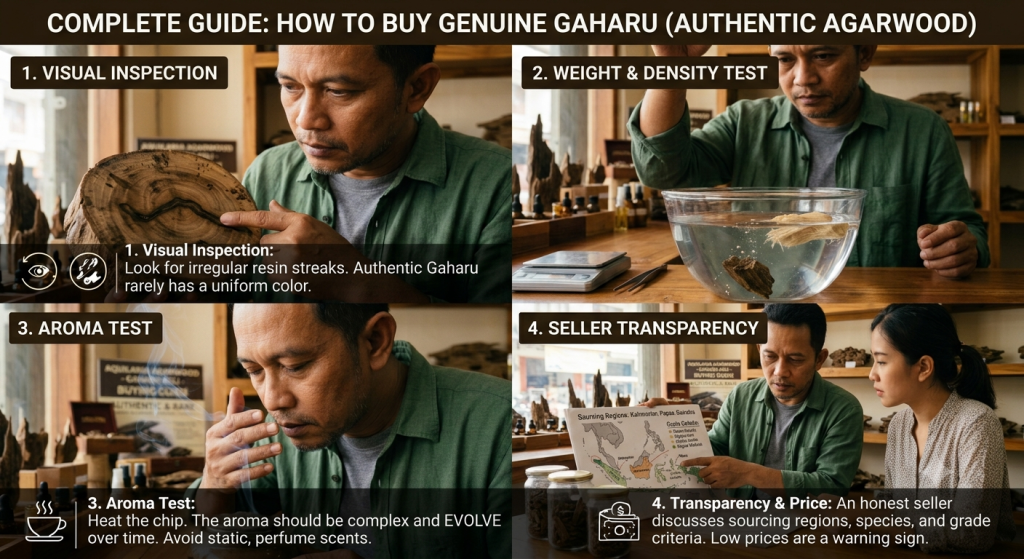
A handful of checks help separate genuine agarwood from lower-quality or synthetic alternatives, whether you’re buying in person or reviewing photos and descriptions online.
Buying Agarwood Oil Specifically
Oil deserves its own note, since it’s one of the most frequently counterfeited agarwood products. Genuine agarwood oil is expensive to produce, given the amount of high-grade wood required per bottle, so unusually low prices for “pure” oud oil are worth treating with skepticism. Ask directly whether the oil is 100% pure distilled agarwood oil or a blend, since many commercial “oud” fragrances use synthetic aroma compounds designed to approximate the scent rather than actual distilled agarwood.
A genuine agarwood oil should also show some batch-to-batch variation in scent, since it’s a natural product derived from wood that varies by species, grade, and origin — a seller offering an identical, perfectly consistent scent across every bottle over time may be relying more on standardized synthetic components than natural extraction.
Buying Raw Wood, Jewelry, and Incense
For raw wood, request clear photos showing resin patterns up close, and don’t hesitate to ask about the sinking test result if it’s not already mentioned. For jewelry, gently ask whether beads are made from genuinely resin-infused wood or treated/scented lower-grade wood, since both are sold in the market but at very different price points and with different longevity of scent.
For incense, check whether sticks or cones are made from actual ground agarwood powder or from fragrance oils applied to a neutral base material. Both exist commercially, but genuine agarwood incense typically costs more and carries a noticeably more complex aroma profile, which is worth confirming before committing to a bulk purchase.
A Simple Framework for Evaluating Any Agarwood Purchase
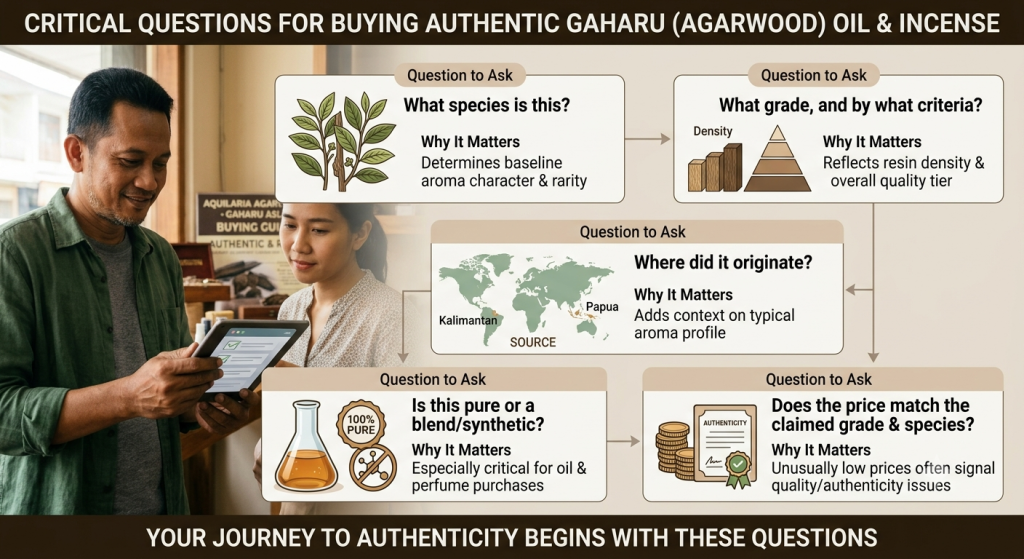
Working through these five questions with any seller, whether shopping in person or online, gives you a far clearer picture than relying on a single grade name or an appealing product photo alone.
Why Sourcing Transparency Matters Beyond Just Quality
Buying agarwood thoughtfully isn’t only about getting a good product — it also connects to the broader sustainability picture surrounding this material. Since all recognized Aquilaria and Gyrinops species fall under CITES Appendix II, legitimate international trade requires proper documentation, and sellers who can speak clearly about sourcing are more likely to be operating within that framework rather than relying on undocumented wild harvest. Our sustainable agarwood guide covers this connection between responsible buying and long-term conservation in more depth.
Common Mistakes First-Time Buyers Make
A few patterns show up repeatedly among buyers who end up disappointed with an agarwood purchase, and most are avoidable once you know what to watch for. One common mistake is focusing entirely on grade names without asking about species or origin at all, which can lead to paying Triple Super prices for wood that, while genuinely dense in resin, comes from a species or region that doesn’t match the aroma profile the buyer actually wanted.
Another frequent misstep is buying agarwood oil purely based on bottle size and price per milliliter, without confirming whether it’s pure distilled oil or a diluted blend. Pure agarwood oil is genuinely expensive to produce, so a large bottle at a bargain price is far more likely to be heavily diluted or partially synthetic than a rare good deal.
A third mistake worth flagging is assuming that because a seller uses confident, technical-sounding language, they’re automatically trustworthy. Genuine expertise usually shows up as a willingness to answer specific questions clearly and consistently, not just fluent use of grading terminology. If a seller’s explanations start to feel vague or inconsistent when you ask follow-up questions about species, sourcing, or grading criteria, that’s worth treating as a signal to look elsewhere or ask for more documentation before committing to a purchase.
Frequently Asked Questions
How can I tell if agarwood is real before buying? Check for uneven resin distribution, test whether chips sink in water, and pay attention to whether the scent evolves over time when gently warmed rather than staying flat and static.
Is cheap agarwood oil ever genuine? It’s possible but uncommon, since producing pure agarwood oil requires a significant amount of high-grade wood. Unusually low prices for “pure” oud oil are often a sign of dilution or synthetic composition.
Should I buy agarwood based on grade or species first? Both matter, but species sets the baseline aroma character while grade reflects resin quality within that species — ideally, you want clarity on both rather than relying on just one.
Does agarwood origin guarantee quality? No. Origin provides useful context about typical aroma profile, but it doesn’t replace verifying species and grade directly, since quality still varies significantly within any single region.
What’s the safest way to buy agarwood online? Buy from sellers willing to discuss species, grading criteria, and sourcing region openly, request photos or samples when possible, and be cautious of listings that rely on impressive-sounding labels without supporting detail.
Ready to Buy Genuine Agarwood from Jungle Agarwood?
If you’d rather skip the guesswork, our team at Jungle Agarwood can walk you through species, grade, and origin options directly and help you find genuine agarwood that matches your needs and budget. Reach out on WhatsApp for current stock and personalized guidance:
Final Thoughts
Learning how to buy genuine agarwood comes down to asking the right questions rather than relying on labels alone — species, grade, origin, and purity all play a role in determining whether you’re getting real value for your money. With the foundation built across species, grading, product types, and origin regions covered in our earlier guides, you’re now equipped to evaluate any agarwood purchase with far more confidence than most first-time buyers ever manage, whether you’re picking up your first bracelet or sourcing high-grade oil for serious perfumery work.
The agarwood market rewards patience and curiosity far more than it rewards impulsive buying. Taking the time to ask a seller a few pointed questions, request a sample or clear photos, and compare pricing against what you now know about grading and species will consistently steer you toward better purchases than chasing the lowest price or the most impressive-sounding label. That habit of buying genuine agarwood thoughtfully is really what separates a satisfying first purchase from an expensive lesson learned the hard way.