
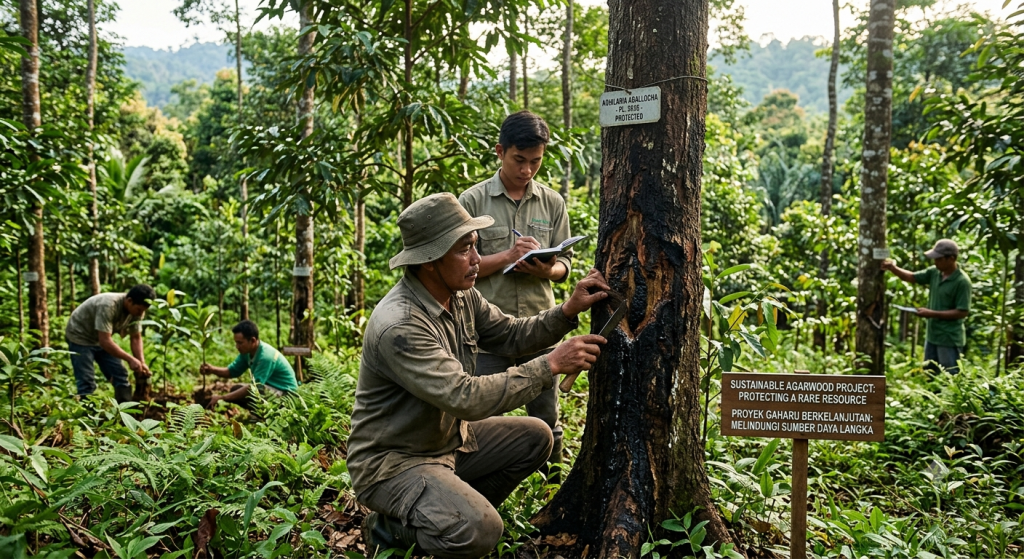
Agarwood’s popularity has always been something of a double-edged sword. The same qualities that make it so treasured — rarity, complexity, centuries of cultural significance — also created relentless pressure on wild tree populations for generations, long before “sustainability” was even a term anyone used in the trade. Today, agarwood sits at an interesting crossroads: demand keeps growing globally, wild resources have become genuinely scarce, and the industry has had to fundamentally rethink how this material gets produced.
We’ve touched on sustainability throughout this series, particularly in our look at how agarwood is formed and how that slow, unpredictable natural process shaped the industry’s reliance on wild harvest for so long. This article goes deeper into what sustainable agarwood actually looks like today — the regulations governing trade, how plantation cultivation has changed the supply picture, and what responsible sourcing means in practice for buyers who care about where their agarwood comes from.
Why Agarwood Became a Conservation Concern
Understanding the sustainability conversation starts with understanding the scale of historical overharvesting. Because natural resin formation only occurs in a small percentage of wild Aquilaria and Gyrinops trees, and because that resin has been in continuous demand across multiple independent cultural traditions for centuries, harvesters historically had strong incentive to search out and fell entire trees just to check whether resin had formed inside — often destroying trees that turned out to carry little or no valuable resin at all.
This search-and-harvest pattern, repeated across generations and accelerating with global demand, put severe pressure on wild Aquilaria populations across South and Southeast Asia. Several species saw significant population declines, prompting conservation assessments that eventually led to formal international trade regulation. Our guide on the types of agarwood covers which specific species have faced the most conservation pressure historically, with Aquilaria malaccensis often cited as one of the species most affected by wild overharvesting.
CITES and the Legal Framework Governing Agarwood Trade
In the early 2000s, all species within the genera Aquilaria and Gyrinops were listed under CITES Appendix II — the Convention on International Trade in Endangered Species of Wild Fauna and Flora. This listing doesn’t ban agarwood trade outright, but it does require export permits and documentation demonstrating that trade won’t threaten the survival of wild populations, creating a formal accountability structure that didn’t previously exist at an international level.
This regulatory shift had real consequences for how the industry operates. Exporters now need to demonstrate legal sourcing, whether from permitted wild harvest or documented plantation cultivation, and buyers moving agarwood across international borders should expect to encounter these permit requirements, particularly for larger commercial shipments. It’s a system that, while imperfect, has pushed the industry toward greater traceability and accountability than existed in earlier decades of largely unregulated wild harvest.
The Rise of Plantation Cultivation
Perhaps the single biggest shift toward sustainability has been the industry’s move toward plantation-grown agarwood, produced through deliberate cultivation and inoculation rather than searching wild forests for naturally infected trees. As explained in our guide to how agarwood is formed, inoculation techniques allow growers to trigger the same resin-producing defense response that would otherwise depend on unpredictable natural infection, but on trees planted specifically for that purpose.
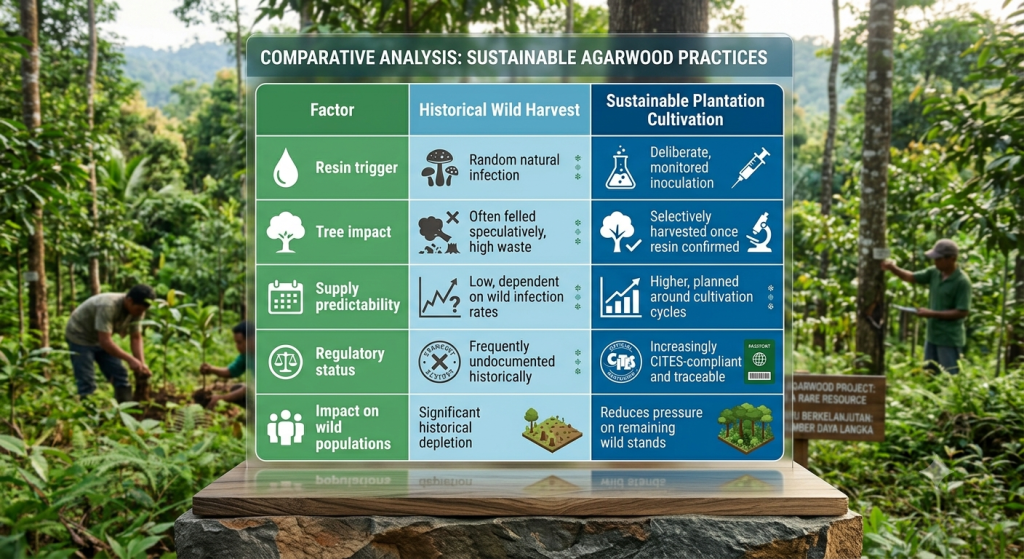
This shift matters enormously for conservation. Rather than searching wild forests and often destroying uninfected trees in the process, plantation cultivation concentrates agarwood production on trees grown explicitly for eventual harvest, reducing pressure on remaining wild populations. Indonesia, Malaysia, Vietnam, and Cambodia have all seen substantial growth in plantation agarwood programs over the past two decades, and today, the majority of legally traded agarwood originates from cultivated sources rather than wild harvest.
Species selection plays into this too. Fast-maturing species like Gyrinops versteegii, widely cultivated in Sumbawa as covered in our guide to agarwood origin regions, have become particularly important to sustainable plantation programs precisely because they shorten the wait between planting and harvest, improving the economics of cultivation as a genuine alternative to wild sourcing.
What Sustainable Cultivation Actually Looks Like
Sustainable agarwood plantations generally follow a few consistent practices, though the specifics vary by grower and region. Trees are typically planted in managed, often mixed-species plots, sometimes intercropped with other agricultural products to support grower income while agarwood trees mature over several years before their first inoculation cycle.
Inoculation itself is usually applied selectively and monitored over time, rather than treating every tree identically, allowing growers to track resin development and harvest individual trees only once they’ve reached a viable stage — a very different approach from wild harvest, where trees were often felled speculatively without any prior confirmation of resin presence. This more measured, monitored approach reduces waste considerably compared to historical wild-harvest patterns.
Some plantations also incorporate broader environmental practices, including maintaining surrounding forest cover, avoiding monoculture in ways that could stress local ecosystems, and working within community-based forestry programs that give local growers direct economic incentive to protect rather than deplete surrounding wild tree populations.
Sustainable vs Conventional Agarwood Sourcing
What Sustainability Means for Buyers
For anyone buying agarwood today, sustainability isn’t just an abstract industry issue — it connects directly to sourcing transparency, which our buying agarwood guide already identified as one of the clearest signals of a trustworthy seller. A seller who can speak clearly about whether their agarwood comes from documented plantation cultivation or permitted wild harvest is generally operating within the CITES framework that governs legal trade, while vague or evasive answers about sourcing are worth treating cautiously.
Buying plantation-grown agarwood isn’t a compromise on quality, either. As covered in our discussion of how agarwood is formed, well-managed inoculation and sufficient development time can produce resin quality that genuinely rivals wild-harvested material, meaning buyers don’t have to choose between supporting sustainable sourcing and getting a high-quality product.
Challenges the Industry Still Faces
It would be misleading to suggest sustainability challenges in agarwood are fully solved. Illegal wild harvest still occurs in parts of Southeast Asia, particularly in remote forest areas with limited enforcement capacity, and demonstrating full supply chain traceability remains genuinely difficult across an industry that spans many small-scale growers and traders rather than a handful of large, easily monitored operations.
Species like certain wild Aquilaria populations remain under real conservation pressure even as plantation supply grows, since demand for premium, older wild material hasn’t disappeared even as cultivated alternatives have become more available. Ongoing research into more efficient, reliable inoculation techniques, alongside stronger enforcement of CITES documentation requirements, continues to be an active area of focus for the industry, conservation organizations, and researchers working to secure agarwood’s long-term future.
Community-Based Forestry and Grower Incentives
One of the more effective approaches to sustainable agarwood production has emerged through community-based forestry programs, particularly in parts of Indonesia and Southeast Asia where local communities live near remaining wild Aquilaria and Gyrinops populations. These programs typically work by giving local growers direct economic stake in cultivating agarwood trees on their own land, rather than relying on income from harvesting wild forest trees that may or may not carry viable resin.
The logic behind this approach is fairly straightforward: when a community’s income depends on trees they’ve planted and are actively managing toward eventual harvest, there’s far less economic incentive to search out and fell wild trees speculatively. Some programs pair this cultivation incentive with broader forest conservation commitments, effectively linking a grower’s agarwood income to maintaining surrounding forest health rather than treating it as a resource to be extracted and depleted.
These community programs have shown real promise in regions where they’ve been implemented well, though scaling them consistently across Indonesia’s vast and geographically dispersed agarwood-producing areas remains an ongoing challenge. Organizations working alongside ITTO and regional forestry departments continue to study which program structures most effectively balance grower livelihoods with genuine conservation outcomes.
Looking Ahead: Where Sustainable Agarwood Is Heading
The trajectory of the agarwood industry over the past two decades points toward continued growth in plantation cultivation, improved inoculation science, and tighter supply chain documentation, though the pace of that progress varies considerably by region and by individual grower. As demand for agarwood continues expanding globally, particularly in perfumery and wellness markets outside its traditional cultural strongholds, the pressure to scale sustainable production methods responsibly is likely to keep increasing alongside it.
For an industry with such deep historical roots in wild harvest, this shift toward cultivation-based sustainability represents a genuinely significant transformation, one that’s still very much in progress rather than fully complete. Buyers who prioritize sourcing transparency and support growers investing in responsible cultivation practices play a real role in reinforcing that shift, simply by asking the right questions and rewarding sellers who can answer them honestly.
Frequently Asked Questions
Is agarwood an endangered species? Several Aquilaria species have faced significant population decline due to historical overharvesting, which is why all Aquilaria and Gyrinops species are listed under CITES Appendix II, though not all are classified as critically endangered individually.
What does CITES Appendix II mean for agarwood buyers? It means legal international trade requires export permits and documentation demonstrating the agarwood was sourced in a way that doesn’t threaten wild populations, which buyers can ask sellers about when purchasing, particularly for larger shipments.
Is plantation-grown agarwood lower quality than wild agarwood? Not necessarily. With effective inoculation techniques and sufficient development time, plantation-grown agarwood can achieve resin quality comparable to wild-harvested material, while placing far less pressure on wild tree populations.
How can I tell if the agarwood I’m buying is sustainably sourced? Ask the seller directly whether the material comes from documented plantation cultivation or permitted wild harvest, and look for sellers willing to discuss sourcing transparently rather than relying on vague claims.
Why did agarwood become so scarce in the wild? Historical harvesting often involved felling trees speculatively to check for resin, since natural infection is unpredictable, which caused significant depletion of wild Aquilaria populations across South and Southeast Asia over past decades.
Support Sustainable Agarwood Sourcing with Jungle Agarwood
Our team at Jungle Agarwood works with transparent, responsibly sourced agarwood, and we’re happy to walk you through where a specific batch comes from before you buy. Reach out on WhatsApp to ask about sourcing, species, and current stock:
Final Thoughts
Sustainable agarwood represents a genuine shift in how this ancient material gets produced, moving away from the speculative wild harvesting that depleted so many tree populations toward carefully managed plantation cultivation guided by CITES regulation and improved inoculation science. For buyers, understanding sustainable agarwood isn’t just about environmental conscience — it connects directly to sourcing transparency, product quality, and the industry’s ability to keep producing this remarkable material for generations to come without repeating the mistakes of its past.
As cultivation methods continue improving and more growers adopt transparent, documented sourcing practices, the gap between “sustainable” and “premium quality” agarwood is steadily narrowing. That’s genuinely good news for anyone who wants to enjoy this material responsibly, without having to choose between the scent they love and the long-term health of the forests it comes from.