
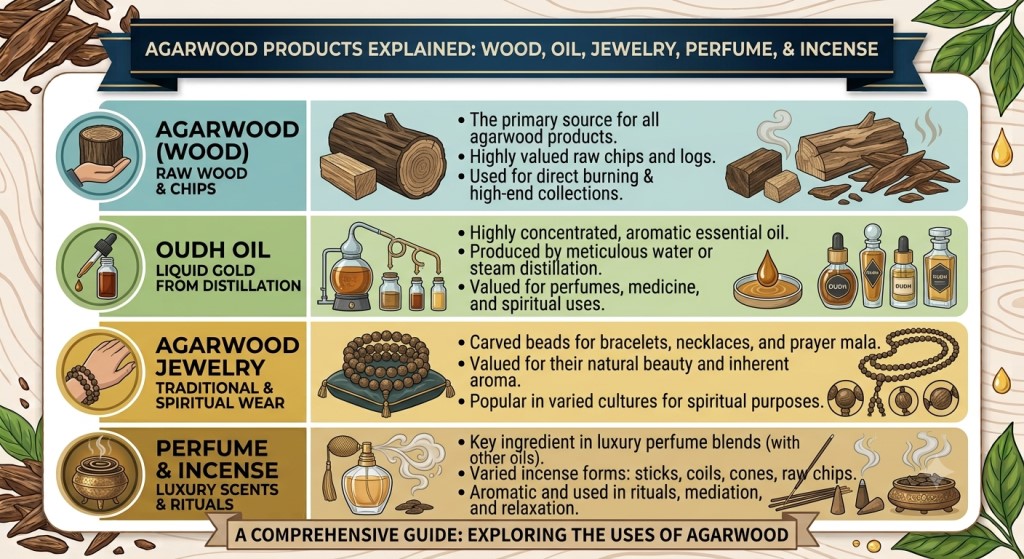
Most people’s first encounter with agarwood isn’t a raw wood chip at all — it’s a dab of oud perfume, a wooden bracelet, or a stick of incense burning quietly in a room. Agarwood shows up in more forms than most buyers realize, and each form serves a genuinely different purpose, price point, and audience. Understanding these product categories makes it much easier to figure out what you’re actually looking for, whether that’s a fragrance, a wellness ritual, or a piece to wear.
At Jungle Agarwood, we sell across most of these categories, and one question comes up constantly from new customers: what’s the actual difference between raw agarwood wood, the oil, and everything made from it? This guide walks through the major agarwood product types — raw wood, oil, jewelry, perfume, and incense — so you can match the right product to what you’re actually trying to get out of it. If you haven’t already, it’s worth first reading our guides on the types of agarwood and agarwood grades, since species and grade quietly shape the quality of every product on this list.
Raw Agarwood Wood: Where Everything Starts
Raw agarwood — sometimes called agarwood chips, gaharu chunks, or simply “wood” in the trade — is the resin-infused heartwood in its most unprocessed form. This is the material everything else on this list eventually comes from, whether it gets distilled into oil, ground into incense powder, or carved into beads.
Raw wood is typically sold by grade, following the classifications covered in our agarwood grades article — AB, Super, Double Super, and Triple Super — with pricing scaling sharply based on resin density and aroma strength. Collectors and incense burners often prefer raw wood specifically because it lets them experience the scent in its most direct form, usually by gently heating small chips rather than burning them outright, which preserves more of the subtle aromatic complexity.
Buying raw wood also gives you the clearest window into species and origin, since chips retain visible resin patterns and can be evaluated directly. For anyone serious about understanding what they’re purchasing, raw wood remains the most transparent product category, a point we expand on in our buying agarwood guide.
Agarwood Oil: The Concentrated Heart of the Trade
Agarwood oil — widely known internationally as oud oil — is produced by distilling resin-soaked wood, most commonly through hydro-distillation or steam distillation, sometimes over a process that stretches for days or even weeks depending on the method and equipment used. The result is an intensely concentrated, viscous oil that captures the tree’s aromatic compounds in a form far more potent than the raw wood itself.
Oil quality depends heavily on the wood that went into distillation. Higher-grade, more resin-dense wood — think Double Super or Triple Super material — produces oil with greater depth, complexity, and longevity on skin. Lower-grade wood still yields usable oil, but typically thinner in character and shorter-lived once applied. This is one of the clearest examples of how grade and species, discussed in our types of agarwood article, translate directly into the finished product’s value.
Agarwood oil is used both as a standalone fragrance, applied in small amounts directly to skin, and as a base note in oud-forward perfumery. It’s also one of the most counterfeited agarwood products on the market, since synthetic oud fragrance oils are far cheaper to produce and can be difficult for inexperienced buyers to distinguish from the real thing without guidance.
Agarwood Jewelry: Bracelets and Necklaces
Agarwood bracelets and necklaces have become increasingly popular well beyond traditional markets, worn both for their subtle, long-lasting scent and for cultural or spiritual significance in various Asian traditions. These pieces are typically made from beads carved out of resin-infused wood, strung together much like other wooden bead jewelry, but valued specifically for the aromatic wood used.
The appeal here is twofold. First, agarwood beads release a soft, natural fragrance that intensifies slightly with body heat, functioning almost like a wearable, understated perfume. Second, in several cultural and religious contexts across Asia, agarwood jewelry carries symbolic meaning tied to calm, mindfulness, or spiritual practice, which adds a layer of significance beyond the scent alone.
Quality varies considerably in this category. Beads made from higher-resin wood tend to carry a noticeably stronger natural scent and a darker, denser appearance, while lower-quality pieces may rely on artificial scenting to compensate for thin resin content — another reason species and grade knowledge from earlier in our content series remains useful even when shopping for jewelry rather than raw material.
Agarwood Perfume: Oud in Modern Fragrance
Agarwood perfume — often marketed under the broader “oud” category in Western and Middle Eastern perfumery — blends agarwood oil with other fragrance components to create a wearable, balanced scent rather than the intensely concentrated pure oil. This category has grown enormously in global popularity over the past two decades, with major fragrance houses releasing oud-centered perfumes alongside traditional attar producers across the Middle East and South Asia.
Not all agarwood perfume is created equal, and this is a category where the line between “genuine agarwood-derived” and “synthetic oud accord” gets blurry fast. True agarwood perfume incorporates actual distilled agarwood oil, contributing real complexity and depth, while many mass-market “oud” fragrances rely entirely on synthetic aroma chemicals designed to approximate the scent without using real agarwood at all. Both have a place in the market, but they’re fundamentally different products, and pricing usually reflects that difference clearly once you know what to look for.
Agarwood Incense (Dupa): The Traditional Aromatherapy Format
Agarwood incense — often called dupa in Indonesian and Malay contexts — represents one of the oldest and most widespread uses of agarwood, spanning religious ceremonies, meditation practices, and everyday aromatherapy across Asia and the Middle East. Incense is typically made either from ground agarwood powder pressed into sticks or cones, or from small raw wood chips burned directly on charcoal.
This format is particularly valued in aromatherapy and wellness contexts, where the slow-burning, woody-sweet smoke is associated with calming and grounding effects, often used during meditation, prayer, or simply to create a particular atmosphere at home. Because incense typically uses more processed or lower-grade material compared to premium raw wood or oil, it tends to be one of the more accessible entry points into agarwood products, making it a popular starting choice for people new to agarwood generally.
Quality still varies meaningfully here too. Incense made from genuine agarwood powder carries a noticeably different, more layered aroma compared to synthetic “agarwood-scented” incense sticks that use fragrance oils rather than actual wood material — a distinction worth asking about directly when buying, especially for aromatherapy use where authenticity of the scent source often matters to the buyer.
Comparing Agarwood Product Categories
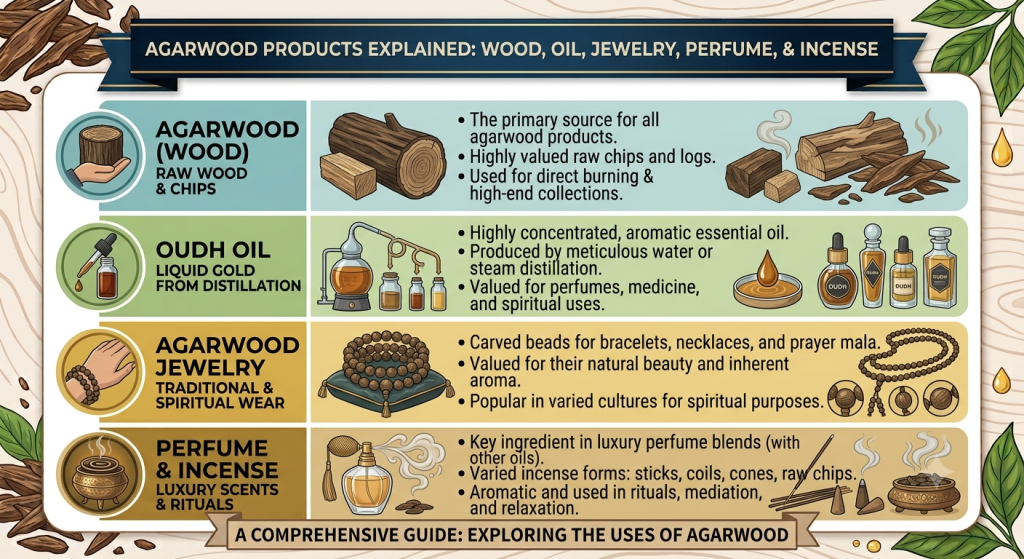
Choosing the Right Agarwood Product for Your Needs
There’s no single “best” agarwood product — the right choice depends entirely on what you’re trying to achieve. Someone looking for a long-term wellness or meditation practice will likely get more value from incense than from an expensive bottle of pure oil. Someone chasing the deepest, most complex fragrance experience will lean toward raw wood or high-grade oil over a diluted perfume. And someone wanting a subtle, everyday connection to agarwood without the ritual of burning anything will probably find jewelry the most practical option.
It’s also worth remembering that these categories aren’t mutually exclusive starting points. Many collectors begin with incense or a modest bottle of oil, then work their way toward raw wood chips and higher grades as they develop a more trained sense of what separates authentic, high-quality agarwood from lower-grade or synthetic alternatives. Our earlier guide on agarwood grades is a useful next step for anyone planning to move in that direction.
Frequently Asked Questions
What is the difference between agarwood oil and agarwood perfume? Agarwood oil is the pure, concentrated distillate extracted directly from resin-infused wood, while perfume typically blends that oil (or, in lower-quality cases, synthetic substitutes) with other fragrance components to create a milder, more wearable scent.
Are agarwood bracelets actually scented, or just symbolic? Genuine agarwood bracelets made from resin-infused beads do carry a real, natural fragrance that becomes more noticeable with body heat, in addition to any cultural or spiritual significance attached to wearing them.
Is agarwood incense the same as regular scented incense? Not necessarily. Authentic agarwood incense is made from real agarwood powder or wood chips, producing a distinctly layered natural aroma, whereas many mass-market incense products use synthetic fragrance oils simply labeled “agarwood scent.”
Which agarwood product is best for beginners? Incense and lower-grade raw wood chips tend to be the most accessible starting points, offering a genuine introduction to agarwood aroma without the cost of premium oil or high-grade wood.
Why does agarwood oil vary so much in price? Oil price is driven largely by the grade and species of wood used in distillation, along with the distillation method and yield — oil from Double Super or Triple Super grade wood is significantly more concentrated and expensive than oil from lower-grade material.
Looking to Try Agarwood Products from Jungle Agarwood?
Whether you’re interested in raw agarwood chips, pure oil, a scented bracelet, or incense for daily aromatherapy, our team at Jungle Agarwood can help you choose the right product and grade for your needs. Reach out directly on WhatsApp for current stock, pricing, and personalized recommendations:
Spotting Authentic Agarwood Across Product Categories
Because agarwood products range so widely in form, the way you check for authenticity has to shift depending on what you’re buying. With raw wood, resin patterns, weight, and the sinking test remain fairly reliable indicators. With oil, authenticity gets harder to verify visually — genuine agarwood oil should carry complex, evolving notes that shift over time on skin, rather than a single flat scent that stays static from application to evaporation, which is often a sign of synthetic composition.
Jewelry and incense present their own challenges. A quick way to check bracelets is to gently warm a bead between your fingers; genuine resin-infused wood will release a noticeably richer scent with warmth, while artificially scented beads often smell more uniform and don’t intensify the same way. For incense, examining the material before burning helps — real agarwood powder or chip-based incense usually shows visible wood texture and color variation, whereas synthetic-scented sticks tend to look uniformly processed.
None of these checks are foolproof on their own, which is exactly why buying from a seller who can speak knowledgeably about species, grade, and sourcing — rather than relying on packaging claims alone — remains the most reliable safeguard across every product category covered here.
Final Thoughts
Agarwood products span a surprisingly wide range — from raw resin-infused wood and concentrated oil to jewelry, perfume, and traditional incense — and each format offers a different way to experience the same underlying material. Knowing what separates these agarwood products, and what each one is genuinely suited for, makes it far easier to choose something that matches your actual goals, whether that’s fragrance, wellness, or simply owning a piece of one of the world’s most storied aromatic woods.