
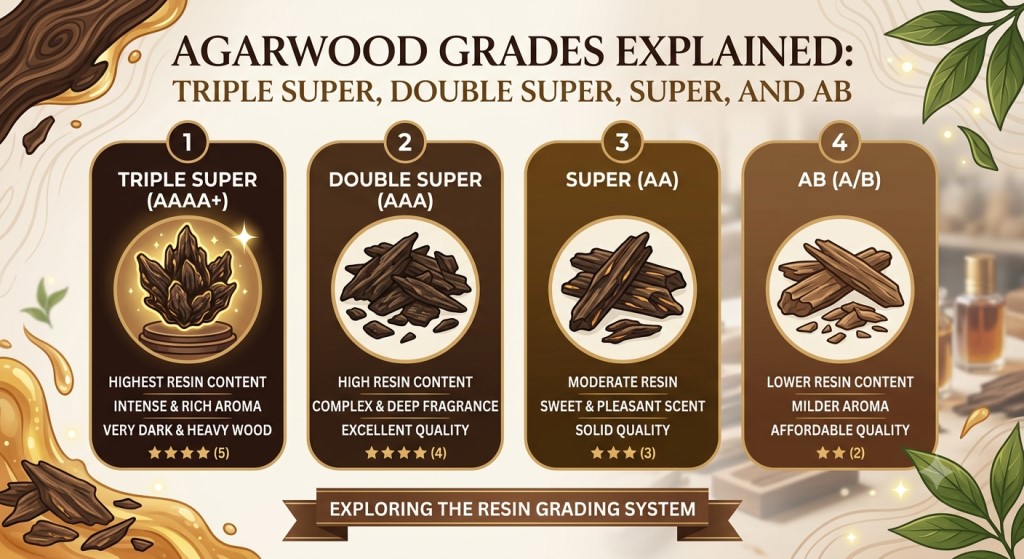
Walk into any agarwood trading conversation and you’ll hear grade names thrown around fast — Triple Super, Double Super, Super, AB — often with wildly different prices attached to nearly identical-looking wood chips. For newcomers, this is one of the most confusing parts of buying agarwood, and honestly, it confuses plenty of experienced buyers too, since grading isn’t governed by a single international standard the way, say, diamond grading is.
At Jungle Agarwood, we field questions about grading almost as often as we get asked about species. And the two topics are connected — if you haven’t already, it’s worth reading our guide on the types of agarwood, since species and origin (Aquilaria malaccensis, Gyrinops versteegii, and others) heavily influence which grade a given batch of resinous wood can realistically achieve. This article picks up from there and focuses specifically on how agarwood gets sorted into commercial grades, what separates Triple Super from a basic AB classification, and how to think about grading when you’re evaluating a purchase.
Why Agarwood Grading Isn’t as Standardized as You’d Expect
Before getting into definitions, it helps to set expectations correctly: agarwood grading is largely a trade convention rather than a scientific classification system. Terms like Super, Double Super, and Triple Super emerged from decades of practice among traders in Indonesia, and while the general hierarchy is widely understood, the exact cutoff between one grade and the next can shift slightly depending on the region, the trader, and even the specific batch being sorted that day.
This matters because it means grading should be treated as a useful shorthand, not an absolute guarantee. Two chips both labeled “Super” from different sellers can still vary in resin density, aroma strength, and overall quality. That’s part of why species identification, origin, and a physical or olfactory inspection remain just as important as the grade name printed on a bag. Our buying agarwood guide goes further into how to combine grade, species, and sensory evaluation into one purchasing decision.
What Actually Determines an Agarwood Grade
Graders typically weigh a handful of factors when sorting agarwood chips or wood pieces into a class:
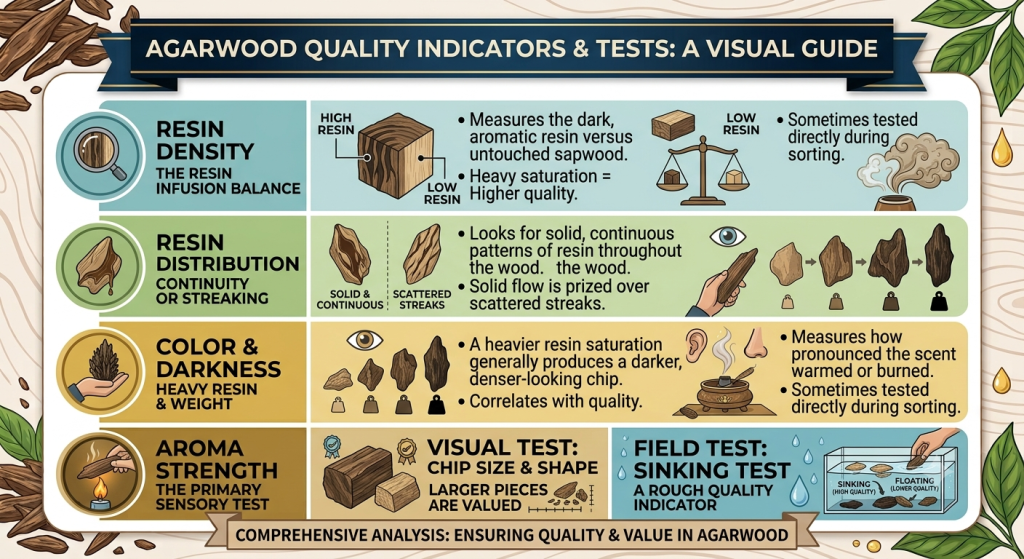
These factors combine to place a batch somewhere on a spectrum that runs, roughly, from low-resin, low-aroma material at the bottom to dense, deeply saturated, intensely fragrant wood at the top. The named grades — AB, Super, Double Super, Triple Super — are essentially labels attached to different points along that spectrum.
AB Grade: The Entry Point
AB grade sits toward the lower-to-middle end of the commercial spectrum. It typically describes agarwood with visible but moderate resin content — enough to carry a genuine agarwood scent, but without the dense, heavily saturated look associated with higher grades. AB grade wood is often lighter in color, with resin appearing in thinner streaks rather than dominating the piece.
This doesn’t mean AB grade is low quality in any absolute sense — it’s simply a different tier, and it plays an important role in the market. AB grade material is frequently used in incense blending, lower-cost oud oil distillation, or as an accessible entry point for buyers who want authentic agarwood without paying premium prices. For many first-time buyers, AB grade is also a sensible way to get familiar with genuine agarwood aroma before moving up to pricier classifications.
Super Grade: A Clear Step Up in Resin Quality
Super grade represents a noticeable jump in resin saturation compared to AB. Chips classified as Super typically show darker coloring, denser resin distribution, and a stronger, more immediate aroma when warmed. This is often considered the first tier where agarwood starts to feel genuinely premium rather than entry-level.
Super grade agarwood is popular among incense burners and mid-range oud oil producers who want a meaningfully richer product without stepping into the price territory of Double or Triple Super material. It’s also a common grade used in gift sets and retail packaging aimed at buyers who want quality they can immediately smell and see, without necessarily needing museum-grade rarity.
Double Super: Where Density and Aroma Intensify Sharply
Double Super grade pushes further into dense, dark, heavily resinated territory. At this level, resin distribution tends to be much more continuous across the piece, color is significantly darker — often approaching black in the most saturated areas — and the aroma is noticeably stronger and more complex, sometimes revealing layered notes that lower grades don’t fully express.
Because achieving this level of resin saturation naturally takes longer and occurs in a smaller percentage of harvested wood, Double Super commands a substantially higher price than Super grade. It’s a common choice among serious oud collectors and boutique perfumers who want depth and complexity without necessarily reaching for the rarest, most expensive material available.
Triple Super: The Top Commercial Tier
Triple Super sits at the very top of the standard commercial grading hierarchy. Wood classified at this level is typically almost entirely saturated with resin, dense enough to sink readily in water, dark — often near-black — throughout, and intensely aromatic even without heating. In many cases, Triple Super chips come from older trees or particularly favorable infection conditions that allowed resin to develop over a longer period with minimal interruption.
This grade represents a small fraction of total harvested agarwood, which is a major reason it carries premium pricing. Triple Super material is typically reserved for high-end oud oil, luxury incense, and serious collectors who prioritize aroma depth and rarity above cost. Some traders further subdivide this tier into additional sub-classifications for exceptionally rare pieces, though naming conventions vary considerably from one supplier to another.
Comparing the Main Agarwood Grades
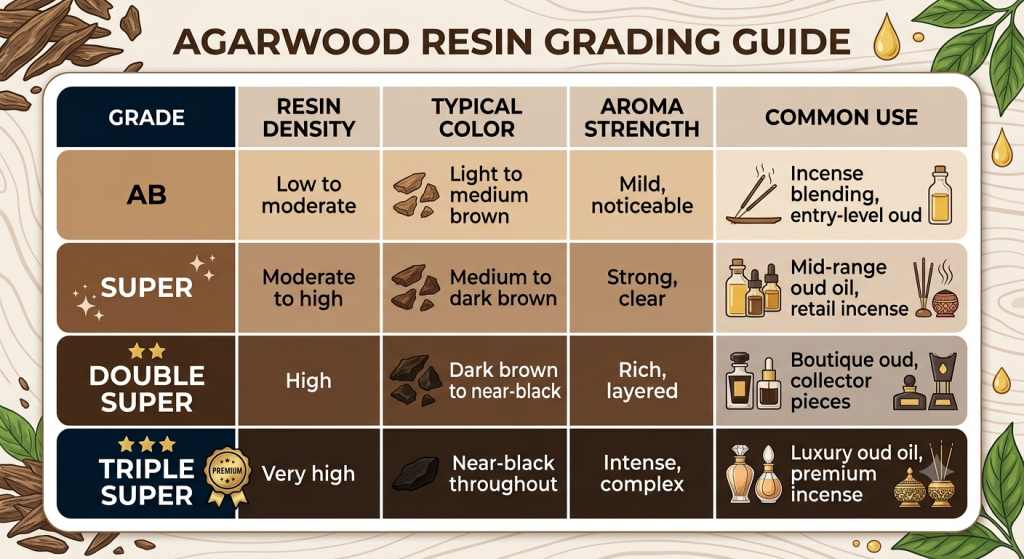
It’s worth repeating that these descriptions represent general industry patterns rather than fixed international benchmarks. A Triple Super batch from one supplier and another from a different region can still show some variation, which is exactly why species and origin — covered in our article on the types of agarwood — remain essential context alongside grade when evaluating a purchase.
How Species Interacts With Grading
Grade and species aren’t independent variables — they interact in ways worth understanding before you buy. Some species, like Aquilaria crassna from Cambodia, are more commonly associated with reaching Double Super or Triple Super classifications due to their naturally dense resin formation. Others, particularly fast-maturing Gyrinops species grown on plantations, more frequently land in the AB to Super range, simply because plantation-grown material often hasn’t had the same extended resin development timeline as older wild or semi-wild trees.
This doesn’t mean Gyrinops can’t reach top grades, or that all Aquilaria automatically qualifies as premium. It simply means grade should be read alongside species and growing conditions rather than in isolation. If you’re weighing a purchase between, say, a Super-grade Gyrinops versteegii and an AB-grade Aquilaria malaccensis, the “better” choice genuinely depends on what you’re looking for in aroma and use case, not just which grade label sounds more impressive.
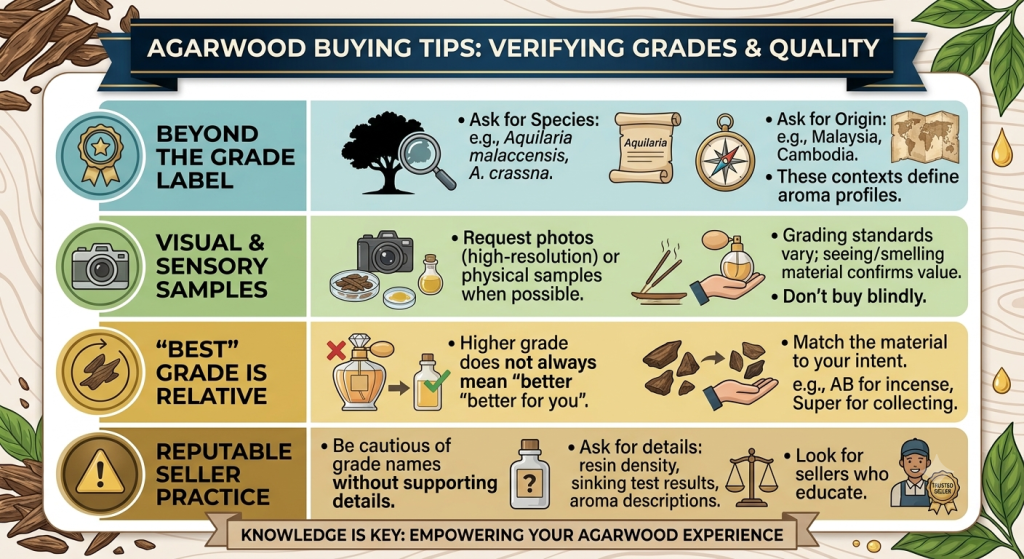
Practical Tips When Buying Agarwood by Grade
A few things worth keeping in mind if grade names are guiding your purchase decisions:
Frequently Asked Questions
What is the highest grade of agarwood? Triple Super is generally regarded as the top commercial grade, representing agarwood with very high resin saturation, dark near-black coloring throughout, and intense aroma even without heating.
What does AB grade mean in agarwood? AB grade refers to agarwood with moderate resin content — genuine and aromatic, but lighter in color and less densely saturated than Super, Double Super, or Triple Super classifications.
Is Double Super better than Super grade agarwood? Generally yes, in terms of resin density and aroma intensity. Double Super typically shows darker coloring and more continuous resin distribution than standard Super grade, which is reflected in a higher price point.
Does agarwood grading follow an official international standard? No. Grading terms like AB, Super, Double Super, and Triple Super are widely used trade conventions, primarily rooted in Indonesian agarwood trading practice, but exact criteria can vary somewhat between individual traders and regions.
Does a higher agarwood grade always mean a better species? Not necessarily. Grade reflects resin density and quality within a given piece of wood, while species reflects the tree it came from. A lower-grade piece from a highly regarded species can still be desirable, and vice versa, which is why checking both is worthwhile.
Interested in Grade-Specific Agarwood from Jungle Agarwood?
If you’re deciding between AB, Super, Double Super, or Triple Super agarwood and want guidance based on your budget and intended use, our team at Jungle Agarwood can walk you through current stock, species, and pricing. Reach out directly on WhatsApp for grade samples and recommendations:
Common Misconceptions About Agarwood Grades
A few misunderstandings come up often enough among buyers that they’re worth addressing directly. The first is assuming grade names are interchangeable with quality guarantees the way a certified gemstone grade might be — they’re not, and treating them that way can lead to disappointment when two “Super” batches from different sellers don’t quite match. The second is assuming a higher grade automatically means a stronger scent for every use case; some incense traditions actually prefer the lighter, more subtle character of AB or Super grade material over the heavier, more concentrated profile of Triple Super wood.
A third misconception worth flagging is treating grade as a stand-in for authenticity. Grade describes resin quality within a piece of wood that has already been confirmed as genuine agarwood — it says nothing about whether the wood is real Aquilaria or Gyrinops resin to begin with, versus artificially scented or treated wood sold under a misleading label. That’s a separate concern entirely, and one worth researching through species identification and reputable sourcing rather than grade alone.
Final Thoughts
Agarwood grades — AB, Super, Double Super, and Triple Super — exist to give buyers and traders a shared vocabulary for resin density and quality, even without a single global standard behind the terms. Understanding what separates each tier, and how grade interacts with species and origin, makes it far easier to buy with confidence rather than guessing based on a label. Whether you’re building an incense collection or sourcing oud oil for perfumery, knowing how agarwood grades actually work turns a confusing shopping experience into an informed one.